
By Anissa Gabbara | Photos provided by Emily Deedler | Read time: 7 min
Key Takeaways
- Elliott Deedler’s life was saved by ECMO technology at C.S. Mott Children’s Hospital when he was 13 months old.
- The Deedler family gives back to U‑M through the Elliott Deedler ECMO Scholar Fund.
- Since treating its first patient in 1981, U‑M’s ECMO Program has cared for more than 4,000 patients.
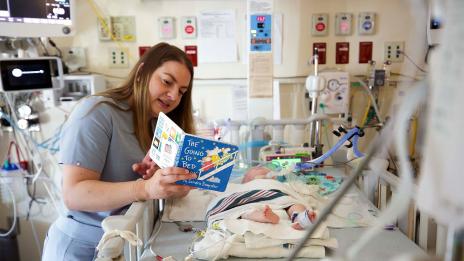
Elliott Deedler knows the true meaning of gratitude. His life was saved by the doctors and nurses at C.S. Mott Children’s Hospital when he was admitted with severe respiratory distress. He was only 13 months old.
Spending hours in the emergency room before ending up on a ventilator, he was diagnosed with human metapneumovirus (a respiratory virus), bacterial pneumonia and, eventually, acute respiratory distress syndrome—shutting his lungs down completely.
When the ventilator wasn’t able to provide enough support, Elliott underwent a procedure to be placed on a temporary life-support machine called extracorporeal membrane oxygenation (ECMO) to help perform the function of his lungs. After being sedated for three weeks, Elliott made a slow yet full recovery.
To continue treating critically ill patients, the Deedler family gives back to U‑M through the Elliott Deedler ECMO Scholar Fund. Established in 2021, the fund supports the training of nurse practitioners and junior faculty in the use of this transformative technology. Additionally, the Deedlers’ five-year commitment has been generously matched by Toyota Motor Company, where Elliott’s father, Adam Deedler (BSEChE ’96, MBA ’04), works as a general manager.
Now, at 15 years old, Elliott is a flourishing high school athlete relishing his teen years. Elliott, who’s still under the care of Mott’s pediatric pulmonary clinic, has no memory of having the procedure, but he is grateful to U‑M’s ECMO team and is inspired to begin a philanthropic journey of his own.
“The ECMO treatment helped save my life, and it can help save other people’s lives,” Elliott said. “Having that in mind really inspires me to keep this fund going.”
Fostering a philanthropic spirit
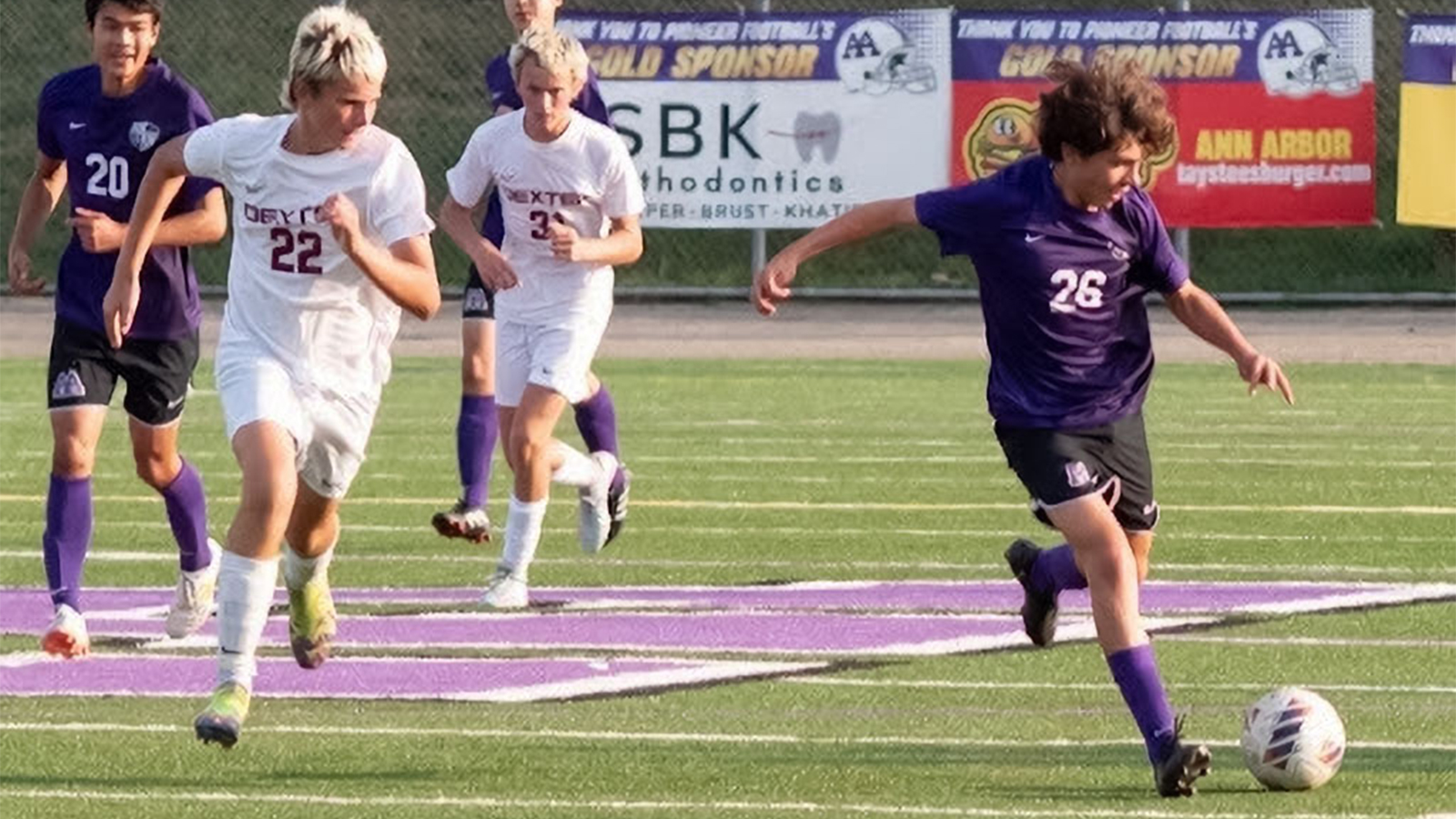
In August, Elliott hosted a charity soccer match at Ann Arbor’s Pioneer High School to support the fund. A collaborative effort with the Michigan Medicine Office of Development, the event raised a total of $4,500. Custom-made jerseys, Michigan-themed gift baskets and all, it’s evident that Elliott doesn’t take philanthropy lightly. It’s an interest rooted in a family tradition of giving back. His mother, Emily Deedler (BBA ’95), director of strategy at Michigan Creative, said philanthropy has always been part of her life.
“I was raised in a culture of philanthropy, and so my parents were always involved in some kind of philanthropy, financially, but really a lot with their time,” she said. “I’m trying to foster that same spirit in my kids.”
Elliott already has the spirit.
“I think philanthropy is so important because not everybody has the same background and the same opportunities,” Elliott said. “And when you have that privilege, you should do something with it because you don’t know who you could be helping and how it could affect things in the future.”
Perfected at Michigan
If it weren’t for the late Robert H. Bartlett (MD ’63), the “Father of ECMO,” ECMO technology may not have evolved into what it is today.
Bartlett, who was an emeritus surgeon at Michigan Medicine and a professor at the Medical School, began his ECMO research as a faculty member at University of California, Irvine School of Medicine. There, he led the team that first successfully used ECMO technology on a newborn in 1975. When he returned to U‑M as a faculty member, Bartlett not only continued his research, but refined the technology, expanding its use to help more patients. Since treating its first patient in 1981, U‑M’s ECMO Program has cared for more than 4,000 patients.
In 2018, Elliott met the doctors and nurses who treated him, including Bartlett himself, at the annual ECMO Survivors Picnic.
“We are forever grateful that Elliott had the opportunity to meet Dr. Bartlett in person,” Emily said. “He changed so many lives, and the chance to thank him was very special to us.”
Spreading the word
ECMO treatment is quite complex. A circuit pumps blood from the body, adding oxygen to it before pumping the blood back into the body, which allows the lungs to recover.
The care team at Mott warned Emily about how risky her son’s procedure would be: “The doctor sat us down and said, ‘We want you to understand that we are doing this because this is the last option before death, and if we don’t do this, he’ll die. So, we have to do this even though this is very risky.’ And then you agree to do it.”
When Emily and Adam were in the hospital with their son, they met a doctor from Portugal who came to the United States to learn about intensive care medicine. About 800 hospitals in 66 countries now offer ECMO as a treatment option.
“Here’s this guy who’s coming here to learn about how we do things, and then he’ll go back to Portugal to spread the word,” Emily said. “So I just really liked the idea of teaching more people about this technology, which I feel is the best way we can contribute to the U‑M ECMO Program.”
The cycle continues
Over the summer, Elliott and his parents attended another ECMO Survivors Picnic, where they met survivors of all ages. These special moments serve not only as a reminder of the impact their philanthropy has had, but as motivation to continue the work.
“When Elliott is raising funds, he’s paying it forward to a kid whose life gets saved, and you don’t know that kid, but you have contributed to saving someone else’s life, and then that cycle just continues,” Emily said.
The plan, Emily said, is to soon turn the Elliott Deedler ECMO Scholar Fund over to her son. Together, they’re brainstorming more ways he can fundraise now that he’s in high school.
For Elliott, having a fund named after him at U‑M is much more than a personal victory; he sees the bigger picture: “It means a lot to me when I see that because it puts into perspective the things I went through, and it really helps me realize that no matter what happened, I can keep moving forward,” he said.
Related Funds
Related Stories
Tags
Related Funds
Charles Woodson Clinical Research Fund - 314916
Your gift represents hope for children affected by life-threatening or chronic diseases. It supports investigators who ha
C.S. Mott Annual Fund - 212560
Your gift to the C.S. Mott Annual Fund will help us respond to needs that may not be met by any other source. This fund i
Elliott Deedler ECMO Scholar Fund - 338150
Gifts will provide support to fellows, nurse practitioners and junior faculty in the Division of Pediatric Critical Care
Related Stories
Smiles, Support, and Something Special
Dance Marathon at Michigan: Student-led joy, donor-powered impact—for the Little Victors at C.S. Mott Children’s Hospi
Raising a toast to a fighting spirit
Miles DiGiannantonio was born with a fighting spirit. After three months in the NICU, he came home without oxygen assi
Stand up. Stay humble.
U‑M legend Charles Woodson offers his words of wisdom on giving back and getting involved.
"Chad winks"
A child’s death. A mother’s grief. A national movement. Leaders & Best sat down with the Carr family and the U‑M r
$10M Mott Foundation grant will help expand complex care spaces at C.S. Mott Children’s Hospital
C.S. Mott Children’s Hospital advances pediatric medicine and improves the lives of children with medical needs.