
By Madeline Swanson | Photos courtesy of Michigan Medicine
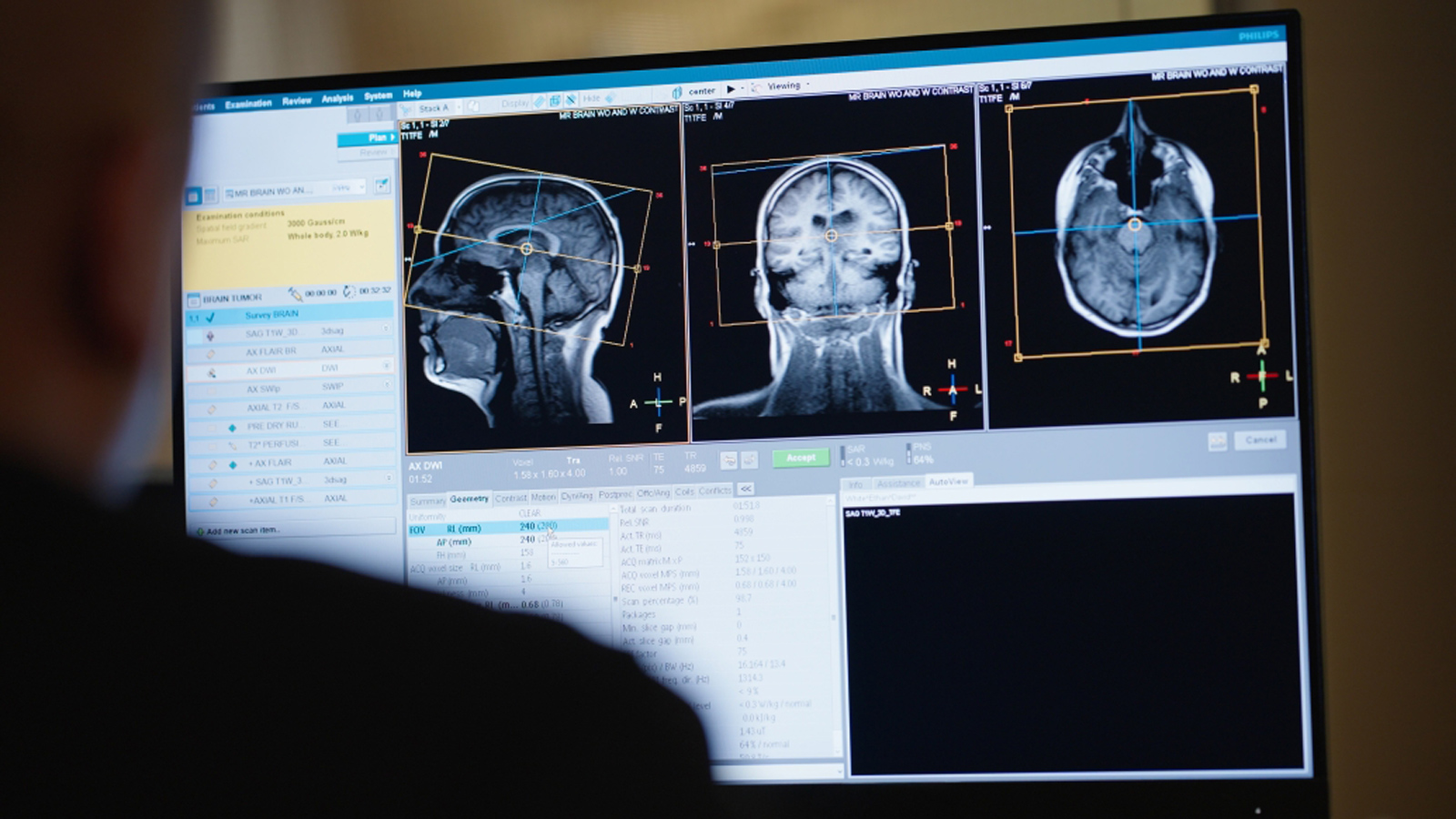
When families arrive at the University of Michigan Chad Carr Pediatric Brain Tumor Center facing a rare cancer diagnosis, conversations today have more hope than they once did.
“There is a very different discussion we have with families than in the past,” said Carl Koschmann, M.D., co-director of the center. “Diffuse midline glioma and diffuse intrinsic pontine glioma are still tumors that are extremely hard to cure, nearly impossible. But we do now have an approved drug, which certainly adds some confidence for these families.”
This turning point represents a milestone years in the making. In 2025, ONC201 became the first FDA-approved treatment specifically for DMG and DIPG—and the first-ever drug approved solely for pediatric brain tumors as a result of discoveries made at Michigan.
Unlike other pediatric brain cancers, DMG and DIPG are aggressive and inoperable due to their location near or in the child’s brainstem, making most targeted therapies often offered to cancer patients too risky for children.
For clinicians, researchers, and families at Michigan Medicine, the approval of ONC201 represents more than a new option to treat this deadly disease. It represents a steady momentum that is powered by collaboration and sustained by philanthropy.
“In 10 years to have something that is FDA approved, it’s very challenging,” said Sriram Venneti, M.D., Ph.D., a neuropathologist, researcher, and co-director of the center. “In one research lifetime, it’s very rare that the work you do actually gets translated almost in real time during your career.”
‘If you build it, they will come’
Opening in 2018, the Chad Carr Pediatric Brain Tumor Center was created in memory of Chad Carr, whose life was taken by DIPG in 2015. He was the youngest son of Tammi Carr (AB ’97) and former Michigan quarterback Jason Carr (AB ’95), and grandson of former Michigan Football coach Lloyd Carr and former All-American Michigan safety Tom Curtis (AB ’70). Propelled by philanthropy, the center was made possible by thousands of donors who believed that childhood brain cancer demanded fewer barriers to finding answers.
From its inception, the center focused on some of the most aggressive pediatric brain tumors—particularly DMG and DIPG. Led by the collaborative efforts of C.S. Mott Children’s Hospital, Rogel Cancer Center, and more than 1,500 dedicated donors, the center brings together expertise from across the University of Michigan Health departments, Michigan Engineering, and Michigan Public Health, as well as international collaborators.
What distinguishes Michigan, he explained, was an early concentration of clinicians and scientists committed to not only understanding the biology of these tumors, but translating that understanding into action.
“We built a portfolio of clinical trials. As the center was starting, we were getting much better at understanding the tumor on the lab and clinical side,” he said. “And that’s really what encouraged patients to come.”
Families began traveling from across the country, often because U‑M was offering trials they could not access elsewhere. Over time, that expertise expanded beyond DMG and DIPG to other high-risk pediatric brain tumors, bolstering the center’s role as a destination for care.
A cascade of changes
ONC201 was not originally developed with pediatric brain tumors in mind. Outside of the university, early studies in adult brain cancers showed the drug was safe, but largely ineffective.
However, there were some younger patients with a specific mutation—H3K27M—that responded to the drug, according to Koschmann. That mutation is a defining feature of DMG and DIPG tumors, and when U‑M researchers looked closer, they uncovered a mechanism different from traditional cancer therapies.
“We discovered that this drug (ONC201) actually changes the mitochondria, and it changes the way the mitochondria process energy in the cell,” Venneti said.
Those changes trigger a cascade of reactions that cause the tumor cells to be less aggressive, ultimately offering a new way to slow the disease, he explained.
The road to FDA approval
In an uncommon turn for drug development, U‑M clinicians saw signs of benefit in some patients before researchers fully understood why the drug worked.
“One of the things that we saw from that phase one clinical trial was that some patients were doing better than expected,” Koschmann said. “Some patients that would be on the therapy for many years saw their tumors continue to shrink. We didn’t actually know why it was working in tumor cells prior to us seeing the signal in the patients, and that’s a little backwards from how we often do drug development.”
By studying patient samples, researchers at the center confirmed that the biological changes observed in the lab were also occurring in children receiving the drug. Fueled, in part, by patient advocacy, that data ultimately became part of the package reviewed by the FDA.
New hope for families
Today, ONC201 can be prescribed outside of a clinical trial. The drug is taken orally once or twice a week and does not require hospital infusions.
“It’s not like typical chemotherapy,” Koschmann said. “It doesn’t require being in the hospital for infusions and provides patients with a better life balance.”
Doctors caution: The drug does not work for every patient, and it is a treatment, not a cure. But its approval has shifted the tone of conversations with families.
“Before, we would say everything we’re doing is experimental; we don’t have anything with a track record,” Koschmann said. “That ability to say there is something that’s approved based on this data does go a long way.”
Philanthropy as the catalyst
Researchers emphasize that this progress would not have been possible without philanthropy. Donor support helped build the center and continues to provide the infrastructure needed to move discoveries forward—quickly. That flexibility, he noted, sets the center apart.
“We don’t want this to happen a hundred years from now. We don’t even want it to happen 50 years from now. We really want to have the energy that helps patients right now. And so for that to happen, we need this massive community of philanthropic support,” Koschmann said.
For Venneti, donors are central to their mission, helping to remove hurdles so they can have a greater impact on patients.
“One of the main challenges is to move ideas from the lab to the clinic, and there are so many barriers, he said. “But Carl and our team have figured out ways to move this work really fast through the center. And that’s because of the donor-funded initiatives.”
More ‘base hits’
Last year marked 10 years since Chad Carr’s passing. In that decade, his legacy has helped reshape pediatric brain cancer research and care at Michigan Medicine and beyond.
While the challenges remain immense, the landscape has changed. Looking ahead, researchers believe progress will come not from a single breakthrough, but from combining advances—what Koschmann likens to a series of “base-hits.”
“I think we often use the analogy in cancer therapy that we are looking for that home run. But I think experts realize that it is going to be less of one big home run and putting together base hits in a way that’s data driven to be able to get these longstanding cures for some of our highest risk tumors,” Koschmann said. “To get to that ultimate home run, that series of base hits, we’re just going to need to keep the team together.”
For families facing these diagnoses now and in the future, the momentum Chad, his family, and countless donors helped create is changing the future of pediatric cancer treatment.
Related Funds
Related Stories


Tags
Related Funds
Rogel Cancer Center Fund - 302706
Your gift enables the cancer center to direct resources where they are most needed or where opportunities are greatest
Charles Woodson Clinical Research Fund - 314916
Your gift represents hope for children affected by life-threatening or chronic diseases. It supports investigators who ha
U‑M Chad Carr Pediatric Brain Tumor Center Fund - 324553
The U‑M Chad Carr Pediatric Brain Tumor Center Fund supports pediatric brain tumor research at C.S. Mott Children's Hospi
Related Stories
"Chad winks"
A child’s death. A mother’s grief. A national movement. Leaders & Best sat down with the Carr family and the U‑M r
Prioritizing prevention
School of Dentistry faculty member is on a mission to improve health outcomes in oral cancer patients.
Rogel Cancer Center receives $50M gift to revolutionize pancreatic cancer care, research
The new Rogel and Blondy Center for Pancreatic Cancer will bring together researchers and clinicians to drive forward
Raising a toast to a fighting spirit
Miles DiGiannantonio was born with a fighting spirit. After three months in the NICU, he came home without oxygen assi

Catalyzing cancer research and care
Donor support makes U‑M a world-class hub for cancer research and care.
Stand up. Stay humble.
U‑M legend Charles Woodson offers his words of wisdom on giving back and getting involved.

Catalyzing cures
A historic gift advances cancer care and research at Michigan Medicine.