By Eric Gallippo
With a motto proudly declaring, “Arts, Knowledge, Truth,” it’s no wonder the University of Michigan is already a leader in the performing and visual arts and in building a culture where creativity thrives. As we enter a new season of exhibits, concerts, and other performances, as well as a new phase in the university’s Arts Initiative, donor support is helping the arts lead the way at U‑M and across Southeast Michigan, where students, faculty, and staff are not only tapping into the arts’ aesthetic values, but also their capacity to take on society’s biggest challenges.
Nurturing an ‘arts ecosystem’
Launched in 2019, the Arts Initiative aims to boost arts opportunities and engagement on campus, and center the arts within the university’s mission. On Sept. 1, Mark Clague, longtime professor of music in the School of Music, Theatre & Dance, began serving as interim executive director. “For me, the fundamental role of the Arts Initiative at the University of Michigan is to recognize and catalyze the creativity that resides in every activity of our campus,” Clague told the University Record. “We need the arts, maybe now more than ever. The arts bring us together as a community, they spark conversation, center controversy, and help us exercise the courage necessary to confront today’s big challenges.”
Leaders from arts and academic units across campus, including the College of Literature, Science, and the Arts (LSA); the School of Music, Theatre, and Dance (SMTD); Stamps School of Art & Design; Taubman College of Architecture & Urban Planning, University of Michigan Museum of Art (UMMA); and University Musical Society (UMS), provide guidance. Sara Blair, vice provost for academic and faculty affairs & arts and humanities, provides strategic leadership at the university level.
“We really have our eyes on making the University of Michigan inherently much more artful—making it impossible for you to leave here as a student without having some deep exposure to or experience with art,” said UMMA Director Christina Olsen. “We want U‑M to be as known for the arts as it is for athletics or engineering or anything else.”
SMTD Dean and Paul Boylan Collegiate Professor of Music David Gier echoed those sentiments.
“The reason U‑M is better positioned than anyone else to pull this off is partly the leadership we have in President Ono, and it’s also the extraordinary assets we have as a university,” Gier said.
Among those assets? Extraordinary students who come to campus already thinking about changing the world.
“They’re not just thinking about the audiences and the concert halls; they’re thinking about how they can engage with the world’s really pressing problems, like climate change and social justice and educational access,” Gier said. “They see the University of Michigan as this amazing institution that effects change, makes the world a better place. And so they want to be part of all of that.”
Driven by support from university leadership, the initiative is expanding funding for arts projects and exploring creative fields by students and faculty. Last January, the university committed $20 million to the effort over the next five years, which will partly be used to fund student arts organizations and research, as well as collaborative faculty projects. Dance historian Clare Croft was recently appointed as director of arts research/creative practice, a new leadership position designed to expand and integrate the arts in faculty research across the university.
Donors are also making an impact. In 2022, a gift from Lizzie and Jonathan Tisch helped launch the Michigan Culture Corps internship program. Administered by the Arts Initiative, the program places U‑M students with paid summer positions at arts and culture organizations in Southeast Michigan.
‘An artful campus is a strong campus’
By increasing opportunities for students to engage with the arts, initiative managing director Chris Audain said the university is fulfilling its mission of cultivating strong leaders, while also elevating the student experience.
“A lot of times we can experience the arts and have joy and happiness, and that’s extraordinarily important,” Audain said. “The arts can also be very challenging, and help us be critical thinkers. An artful campus is a strong campus.”
There is no shortage of ways to engage with the arts at Michigan, from UMS and SMTD performances to exhibitions and programs hosted by UMMA, Stamps, and Taubman to countless guest lectures, lessons, and master classes and arts-related student organizations and extracurriculars. Amplifying that signal across campus this fall is a theme semester focused on the ability of art and artists to shape society. Offered by UMMA, The Arts Initiative, and LSA, “Arts & Resistance” includes public performances, courses, lectures, conferences, exhibits, and workshops exploring how creativity can overcome oppression and act as a catalyst for change.
Culture in the community
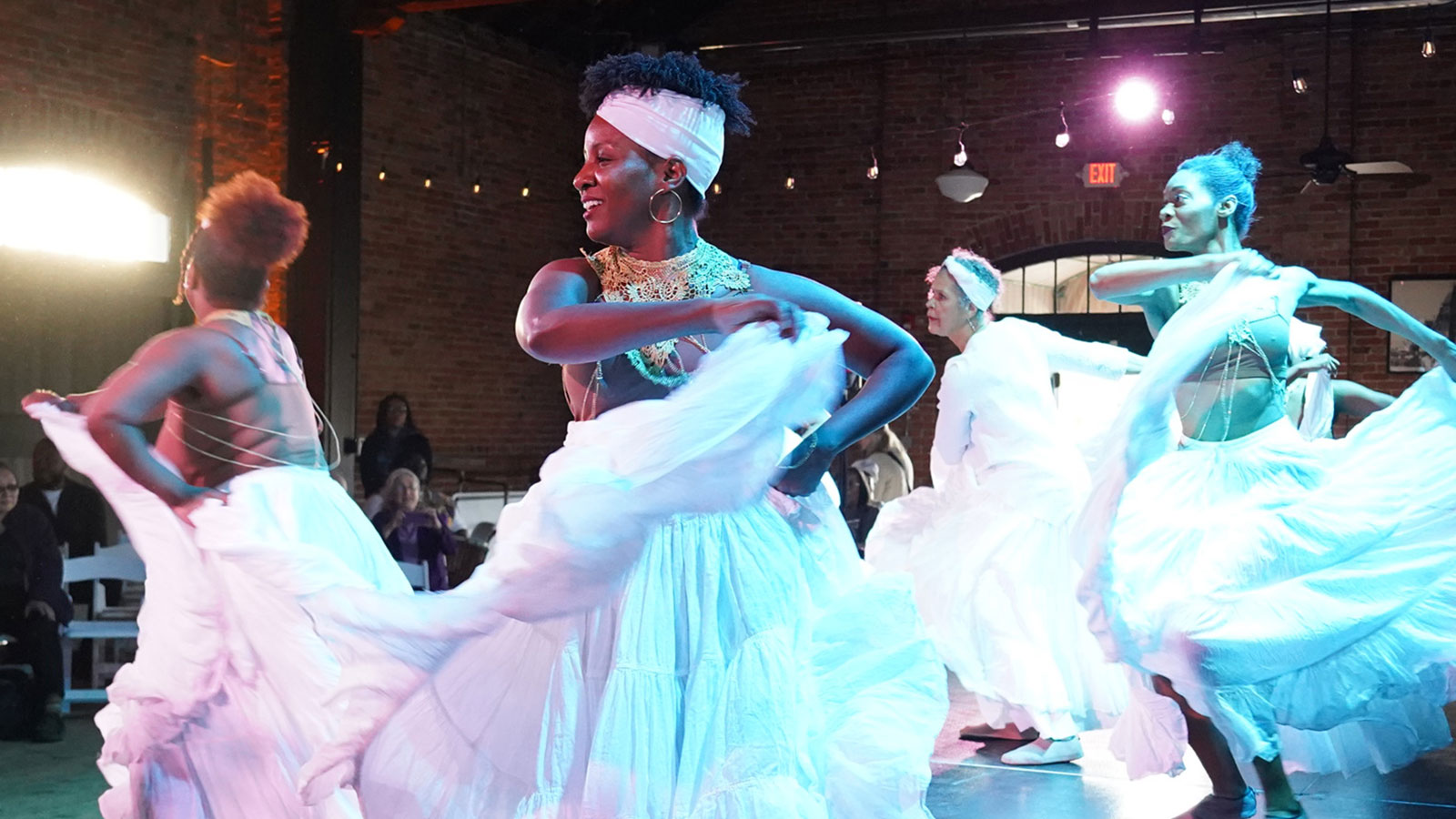
Beyond campus, UMS is also working with the City of Ypsilanti to offer performing arts in its historic Ypsilanti Freighthouse venue. Following a successful pilot run last spring, the two-year partnership officially kicked off this month and includes four weeks of music, dance, theater, and kids and family programming through early October. Admission is free or pay-what-you-will, with early ticketing priority given to Ypsilanti residents. UMS President Matthew VanBesien said the schedule was created with input from the local community, including a new commissioned work by Detroit saxophonist Marcus Elliot celebrating the city’s history and place on the Underground Railroad.
“We’re really trying to be a partner in service to a community that historically has been under-resourced on the arts front and partnering with local artists, giving them a chance to shine in their own community, and then selectively bringing in some other artists from the region and outside of the region to complement them,” VanBesien said.
Support for the series came from donors Menakka and Essel Bailey and Matt and Nicole Lester, as well as a grant from the Community Foundation for Southeast Michigan, with additional funding by Michigan Medicine and from Helga and Jerry Bilik.
“This kind of project is so unbelievably dependent on philanthropy, and you want it to be, so that you can do it with confidence and that you can do it in a way that’s truly bringing net investment to the table and putting resources into the community,” VanBesien said.
Similarly, the Arts Initiative’s Culture Corps program was able to hit the ground running last summer thanks to initial support from the Tisches, allowing students—particularly those from non-arts backgrounds—to explore arts and cultural organizations including Detroit Public Theater, Wright Museum of African American History, The Arab American National Museum, Detroit Opera, Metropolitan Museum of Design Detroit, and more.
“It really gave us the extended on-ramp to develop the program, knowing that it had enough support to go beyond just a one-time, one-off approach,” Audain said. “We were resourced enough to launch it in earnest, and it’s been great for the students and the organizations.”
For her internship, alumna Andrea Medina (AB ’23) worked on writing for the Arts & Economic & Prosperity project with arts advocacy nonprofit Creative Washtenaw, where she also worked on updating websites, data collection, organizational platforms, and grant and proposal writing.
“This mini course guided me to look at art spaces and organizations with a more critical lens, and later be able to experience first hand the work that happens behind the scenes of art and creative organizations,” Medina said.
“Besides having an interest in a career in STEM, I am also an artist,” said fellow 2022 intern Elizabeth Cervantes (LSA Class of 2024). “I have found it difficult to balance these completely opposite paths, but this program allowed me to have a set time to get creative.”
Donors supporting the arts at U‑M
From student scholarships and exhibition support to the Penny Stamps Speaker Series, UMS programming, and SMTD’s EXCEL Lab for arts entrepreneurs, philanthropic support helps make the arts a vital component of the Michigan experience for students—and the greater community.
“We are thrilled to see the creative ways in which UMS has expanded its reach to bolster the arts in our region,” said Menakka and Essel Bailey in a statement to Leaders & Best about their support for the Ypsilanti Freighthouse Series. “The diversity of programming and family appeal is wonderful to experience, and we are proud to support it.”
Talking about their gift to the Culture Corps program last February in a joint statement published by Michigan Today, Lizzie and Jonathan Tisch said, “We are excited to support the bold vision of the Arts Initiative, especially its goal to fully integrate the arts into a Michigan education and encourage all students to deeply engage with the arts and art-making during their time on campus.”