
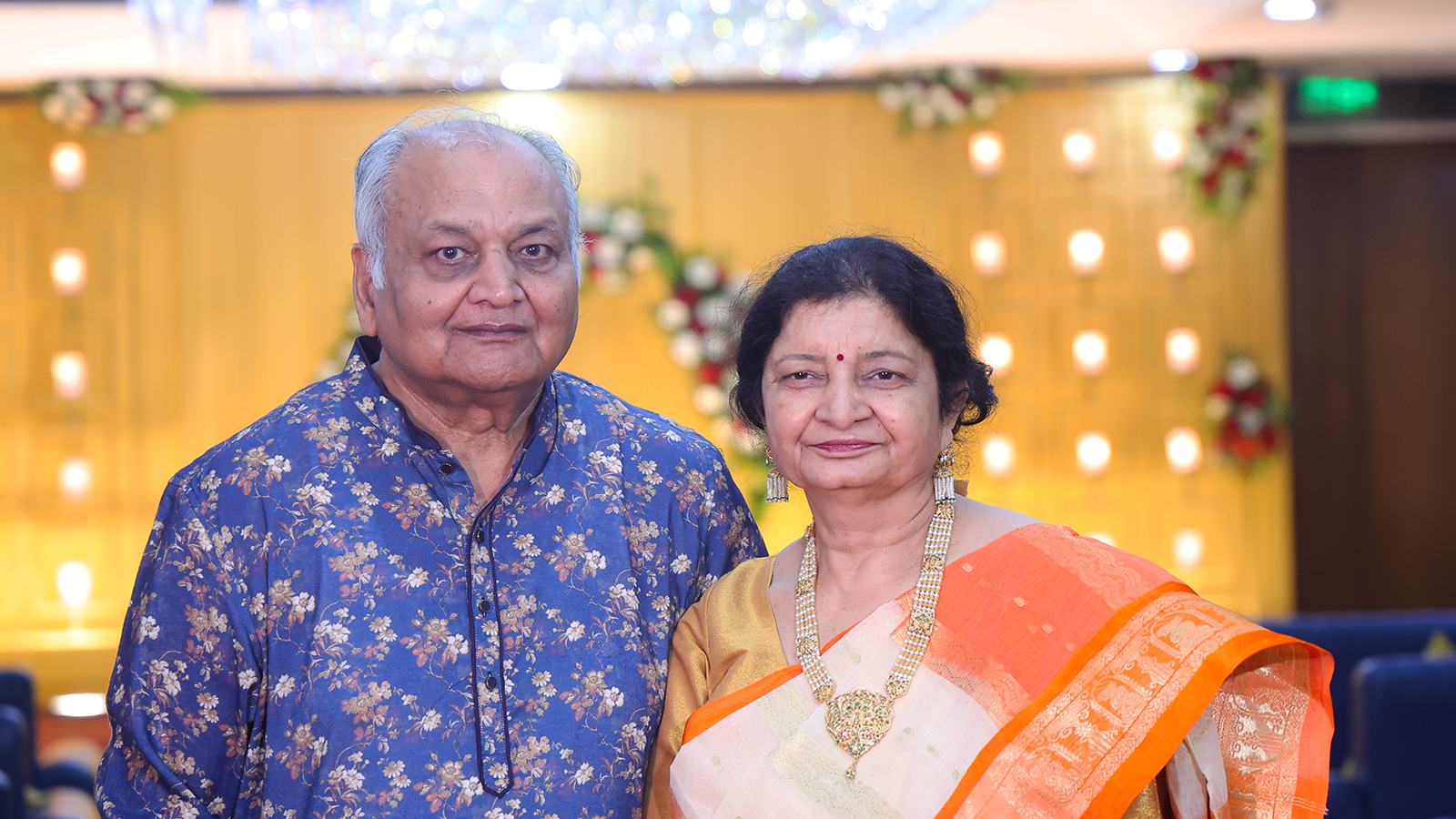
By Sara Carrier and Gayatri Penmetsa | Photos courtesy of the Jain family
Ashok Jain (PhD ’78) has built a distinguished career as a civil engineer, researcher, and educator whose work has shaped the field of earthquake engineering. His path to Michigan began in India, where he excelled as a top student before pursuing doctoral studies in Ann Arbor. Jain’s time at U‑M not only gave him groundbreaking research opportunities, but also instilled lessons in resilience, mentorship, and community that guided his professional journey.
This year, Ashok and his wife, Sarita, established the Sarita and Ashok Jain Endowment Fund to support U‑M graduate students in STEM fields. Going Global spoke with Ashok about his decision to study at Michigan, the impact of his research on his career, and how the support he received in Ann Arbor inspired his family’s commitment to giving back.
- Tell me about yourself. What brought you to the United States, why did you choose the University of Michigan?
I was a university topper throughout my academic career. I was decorated with several gold and silver medals, and scholarships at the Meerut University (now known as Chaudhary Charan Singh University, Meerut) and University of Roorkee (now known as Indian Institute of Technology Roorkee). I wanted to pursue higher education in an area of practical application . I wanted to pursue higher education in an area of practical application with immediate benefit to society. After my master’s program, I applied to some of the top universities in Britain and the United States. I received acceptance letters from Imperial College London; University of Bristol; University of California, Berkeley and University of Michigan, Ann Arbor. It was indeed a very tough decision. I was advised to select the United States over Britain on the parameters of quality of research, overall life, and future prospects. So now the choice fell between Ann Arbor and Berkeley. I was told that the average time to complete a PhD at Berkeley in civil engineering was at least five years, whereas, it was quicker in Ann Arbor. They do not let go of a trained researcher so easily at Berkeley. Moreover, the research topic at Ann Arbor was related to buildings with extensive laboratory research. The research topic at Berkeley was too theoretical. Thus, the choice was obvious. I submitted my doctoral thesis within 30 months of arriving in Ann Arbor and got the degree in the summer of 1978.
- What has your career path—and life in general—been like since graduating? How did your experience at U‑M influence your career path and make an impact on your career?
There was no problem in adjusting to the new environment in the U.S. It was a very smooth sail. There was some teething problem with the laboratory work. The electronic control panel of the Gilmore machine had become faulty and the company had vanished. I kept struggling for a few weeks. My supervisor advised me to read the circuit diagram and figure out the fault. Being a civil engineer, the electronic circuits were Greek to me. Back home, I did take courses on electronics and electrical sciences, but this was a real life problem. Finally, my co-supervisor, Bob Hanson, came to the laboratory and guided me to debug an electronic circuit. He said debugging an electronic circuit was similar to debugging a computer program. This analogy was an entirely new perspective for me.
This was pioneering research in the area of post-buckling behavior of steel bracing members used for earthquake resistance in buildings. It gave me an unprecedented insight into the stress-strain behavior in the strain-hardening region and force-deformation behavior in the non-linear region of a structural steel element. Everything was unfolding before my eyes. The behavior was being recorded on a Honeywell plotter using LVDTs and load cells. It was too real! The overall impact of this research (gave me) an absolute confidence in theoretical and experimental research. Obviously, it had an everlasting impact on my career path.
While at the U‑M, I took courses from the stalwarts of civil engineering, such as, professors Glen V. Berg (PhD ’58), Frank E. Richart and Richard D. Woods (PhD ’67). I saw Professor Victor L. Streeter (BSECiv ’31, MSE ’32, ScD ’34) punching his own computer code, standing in a long queue among students with the punched card deck, waiting for his turn in the computer center. I took a course on finite element methods from Professor William Anderson, aerospace department on North Campus—a very jolly and a soft-spoken gentleman! Once he threw a party for graduate students at his home—the theme was to tell a bigger lie!
My research work at U‑M and later at IIT Roorkee inspired me to write a text book on Dynamics of Structures with Earthquake Engineering for graduate students, published by Pearson India in 2016. Now in its second edition. - Your transformative experience at the University of Michigan inspired a lifelong commitment to education and mentorship. Can you talk about the inspiration behind the Sarita and Ashok Jain Endowment Fund, which supports Rackham graduate students pursuing degrees in STEM fields.
On June 25, 1975, an emergency had been imposed by Mrs. Indira Gandhi, prime minister of India. There was total chaos in the country. People were getting arrested on slight or no pretext and without any trial. Everyone was scared. In such a situation, me and Sarita got married on July 12, 1975. There was a limit on how much foreign exchange (money) one can get from the bank. On August 30, 1975, we flew into Ann Arbor with bare minimum dollars in our pocket. For a few days, we stayed in the University Towers with two Indian graduate students from Mumbai. We were not aware of the concept of health insurance. Back home at the University of Roorkee, the complete medical facilities were available free of cost to the students and faculty (true, even today). But soon I realized that my health insurance would not cover Sarita’s pregnancy.
I received enormous help and support from various counselors at the loan desk, housing desk, the manager at the women’s hospital, classmates, teachers, and friends on the campus. The entire hospital bill was paid for by some grant at the U‑M hospital. The help offered by the International Neighbors, a lady’s club supported and run by local Ann Arbor ladies, was amazing. We always felt just a phone call away in our new home, Ann Arbor.
All these years, both Sarita and I felt that we need to pay back U‑M to help someone who may be in a similar situation as we were 50 years ago. We owed our stay in Ann Arbor to those strangers who helped us in every possible manner. We remember the students driving the U‑M bus during extreme snow so that people living on North Campus could go to the library, computer center, GG Brown lab, concerts on Central Campus, or to the market to buy groceries at any hour of the day and night.
Finally, the endowment fund happened on March 18, 2025.
- How did the support you received while at U‑M ultimately inspire you to give back?
There were lots of similarities between the campus life at IIT and U‑M. Roorkee, a very small and calm town, and center of excellent educational facilities from kindergarten to the university level, situated on the banks of the Upper Ganga Canal and foothills of the Himalayas provided an excellent work environment to meditate and learn. So was Ann Arbor, a very small, calm, and peaceful town on the banks of the Huron River, hosting so many centers of learning all around it. On many occasions, we felt extremely home sick and wanted to go back for a few days. But the counselors at the American Embassy, New Delhi, were very tough guys. Anyone who visited the embassy to get F-1 or F-2 visas renewed to re-enter the United States ran a risk of getting rejected and stranded for an indefinite period in India. So, we decided to stay back, finish the work, and enjoy the support and company of friends and well-wishers at U‑M.
Sarita and I spent the longest ever four-year honeymoon in Ann Arbor and returned home with a very cute baby girl, Payal, a piece of paper called a PhD degree, and tons of sweet memories. I think it is sufficient inspiration to give back.
Related Stories
Tags
Related Funds
Sarita and Ashok Jain Endowment Fund - 703358
Established by Dr. Ashok Jain (Ph.D. 1978, Civil Engineering), this fund supports Rackham graduate students pursuing degr
Related Stories
Committed to making a difference
Alumnus and business leader Choon-Peng Ng (MBA ’04) discusses the importance of international involvement, his excitem
Pan-Asia Alumni Scholarship marks 10 years of impact
Established in 2014 by a group of Hong Kong alumni, the award has supported 17 students from seven countries so far
Danny Dang: Leading by doing
U‑M alumnus and San Francisco Bay Area Michigan Ross Alumni Club president Danny Dang discusses the importance of stay