By Stephanie Wong, Michigan Medicine | Photos by Michigan Photograph
It’s a typical day at the hospital for Dashiel. His job, which is based in several units at University of Michigan Health C.S. Mott Children’s Hospital, demands a lot from him, but luckily, he always comes prepared. He brought his Mcard ID — clipped securely to his vest — a big smile, and a good attitude. As a Lipschutz-Danzansky Family Paws4Patients Program therapy dog at Michigan Medicine, he doesn’t need much else: just someone to love on and care for.
One of his handlers, Mary Breakey, stands by Dash’s side as he works in the family lounge at the Coach Carr Pediatric Cancer Unit. “Our job is to support, nurture, and love families,” she says. The team works out of the lounge, which Breakey affectionately calls “Grand Central Station.” Families, patients, and providers circulate in and out of the room, and Dash, age 4, greets them all with a gentle smile and a cuddle.
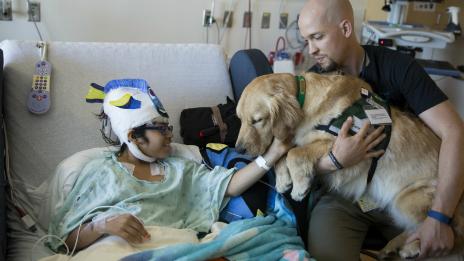
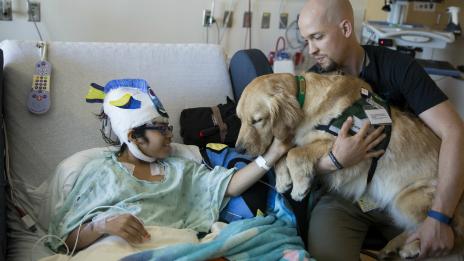
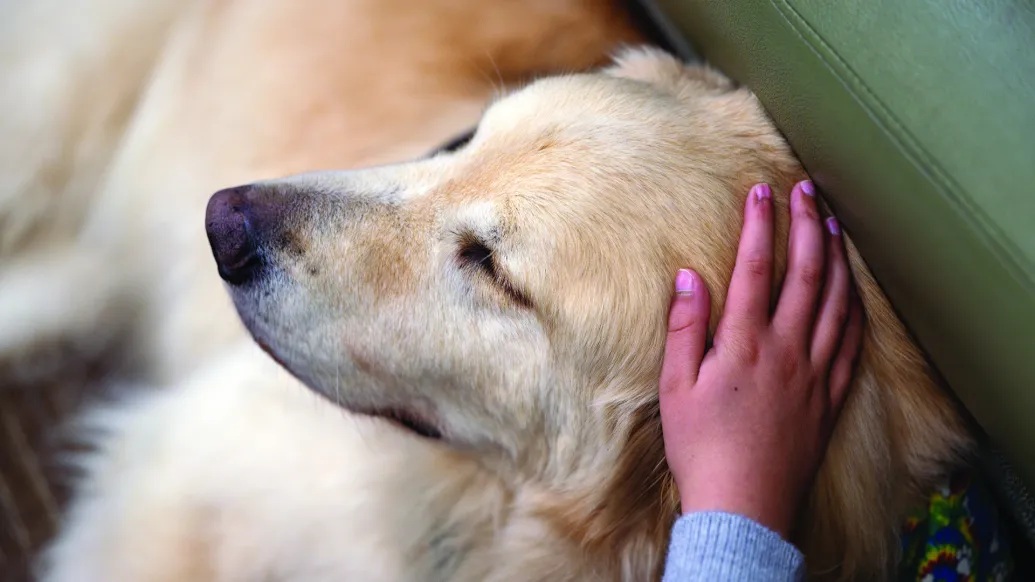
Patient Tristan Kreeger, age 10, says Dash is his favorite Paws4Patients dog. When Dash visits him in his room, the dog hops right onto the bed for a snuggle. Breakey knows Kreeger well. “The two of them have a special bond,” she says. As Dash does his “Comfort Rounds,” he greets people literally where they are: sometimes in their beds, and sometimes at the threshold of their rooms when visitors aren’t allowed inside. No matter how people encounter Dash, they warm instantly to the gentle giant.
Dashiel and his six colleagues Anna, Fawn, Bugle, Barney, London, and McCoy were all trained by Canine Assistants, a nonprofit organization based in Milton, Georgia. The golden retrievers are raised for hospitals and medical facilities to be a comforting presence, providing patients and staff with unconditional,
uncomplicated love.
The first dogs at Michigan Medicine, Denver and Anna, were funded by the Laurence Polatsch 9/11 Memorial Fund. With additional gifts from the Cozad Family/Krantz Family Foundation, Canine Assistants carefully took Michigan Medicine’s needs into consideration in order to match them with dogs who would best serve the community. The program continues thanks to a generous donation from Lainie and Kenny Lipschutz, who are both U‑M alums. Their gift supports basic expenses like veterinary care and grooming for the dogs as well as opportunities for the program to grow in other directions based on the hospital’s needs.
At 10 years young, Anna is still working at Mott and at adult inpatient units within the hospital. She has shown no signs of wanting to retire yet. Christina Wright, associate director of spiritual care and one of Anna’s handlers, marvels at the dog’s empathic abilities. If she senses that somebody needs her, Anna won’t walk by until she has comforted them. “People’s distress may not be evident to me,” Wright says, “but Anna senses it and guides us to the work she needs to do. Her loving and calm demeanor brings about a deep peace even in the most difficult moments.”
Traversing the winding hallways of Michigan Medicine, it’s astounding to see how every single person lights up at the sight of a Paws4Patients dog. Each handler carries a stack of trading cards — complete with a photograph of the dog, their name, age, and other fun trivia. Often, when people see a dog they don’t usually encounter, they jump at the chance to meet the dog and collect their card. It’s easy to see why; the dogs love on their devoted fan base as much as people dote on them.
Off the clock, the dogs live normal canine lives: playing ball, getting their zoomies out, counter-surfing, and being mischievous. Their personalities shine through, too. Elderly Anna, for instance, was the runt of her litter and now makes up for it in sass and stubbornness. While playing with her colleagues, she barks at them to keep the younger ones in line. Two-year-old London is so happy to work that she runs into the hospital every day, knowing that she is about to do the job that she loves. Barney, age 4, is notorious for his goofy, fraternity-brother energy in and out of his working environment as well as his passionate, undying love for balls.
Wright, Anna’s handler, has also noticed that Anna has a remarkable instinct to protect her own wellbeing. “She takes in a lot of emotions in her workday,” Wright notes. “And while she is a hard worker, she also knows when she needs to take care of herself.” One of her self-care strategies of choice: stealing food from her toddler human brother.
Sometimes, the dogs go on retreats with their handlers to come together as a community. When they all get together, they’re a rambunctious golden blur — jockeying for treats, toys, and pets from their humans. Social worker Valerie Evans, one of Bugle’s handlers, admires their lifestyle. “They work hard,” she says, “but they play harder.”