

Photos by Michigan Commons and Michigan Photography
With annual research volume that exceeds $2.16 billion, U‑M is widely regarded as one of the top research institutions in the world. Our research capabilities and accomplishments span nearly every field of science, engineering, medicine, social sciences, the arts, and humanities, and we foster robust collaboration among faculty, staff, students and external partners, positively impacting nearly every facet of society.
Dr. Arthur Lupia is vice president for research and innovation at the University of Michigan, where he is responsible for fostering the excellence and integrity of research across all three campuses. He has vast experience as a researcher, administrator and educator, whose federal service spans two U.S. presidential administrations. We asked him a few questions about the most impactful projects being done today, the tremendous breadth of our research enterprise, and the importance of philanthropic partnerships for research at U‑M.
What is the importance of research currently being done by the university and what are some of the most impactful projects?
Research at the University of Michigan matters because it solves real problems that affect people’s lives.
That includes life-saving medical advances, but it goes well beyond that. U‑M researchers are using artificial intelligence to detect disease earlier and improve clinical decisions. Researchers are developing technologies that strengthen manufacturing and mobility. They’re improving how we manage natural resources, protect water quality and design systems that help communities plan for a more resilient future.
What connects all of this is a deep commitment to our public mission—to serve the people of Michigan, our nation, and the world. Our research moves from discovery to impact. It’s about both generating knowledge and delivering research outcomes that people can rely on.
This research impacts an enormously broad range of people and disciplines, from life-saving medical treatments to fueling economic development. Can you speak to the tremendous breadth of the research enterprise at U‑M?
The university’s greatest research strength is its breadth and, more importantly, how that breadth works together. Few universities in the world can bring together expertise in medicine, engineering, data science and the social sciences at Michigan’s scale. Our most innovative researchers don’t work in silos. They collaborate across schools, campuses and disciplines to tackle problems from multiple angles—together.
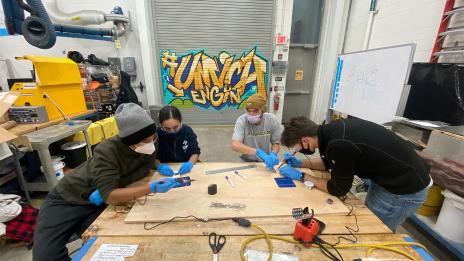
That means a medical breakthrough might involve engineers and AI experts. A job-creating innovation might draw on health data, technology and public policy. And what’s even more interesting is that our students are part of that process, from first-year students in the Undergraduate Research Opportunity Program to our most advanced doctoral students.
This breadth allows U‑M to address complex challenges that no single discipline and no smaller institution could solve alone. It’s an enterprise that is comprehensive, and one of our topline goals is to make it more and more coordinated.
What is the importance of federal funding to U‑M’s research enterprise and what would be the consequences of that funding being cut?
Federal funding is critical to our research enterprise and ensures stability and long-term impact.
It helps to cover the infrastructure that allows researchers to do their jobs effectively, including the laboratories, equipment, compliance systems and highly skilled staff. It also allows U‑M to train the next generation of scientists, clinicians, and innovators.
The most important thing about federal funding to understand is that the university takes this public investment and turns it into tremendous public benefit. Federal support becomes medical advances, economic growth, and knowledge that serves the nation. These are real consequences that affect the lives of people across our state and all over the nation.
We know that U‑M developed a new research funding program in response to federal stop-work orders impacting the university’s research enterprise. Can you explain that and what’s been funded so far?
One of my most important responsibilities as vice president is to make sure our research enterprise continues to move forward.
Early last year, the university created a targeted research funding program to provide short-term support for researchers whose federally funded work was interrupted. The goals were to help researchers adapt to new circumstances and preserve work that saves lives. Since the program began, the university has invested about $1.3 million in central funds to help critical research continue.
We’ve since expanded the program to support faculty whose grant proposals received strong peer reviews, but have not yet been funded. This bridge support helps researchers maintain momentum and remain competitive for future opportunities.
The political and cultural climate are shifting in major ways. You have characterized this as an opportunity. Can you speak to new ways we as a university can meet this moment and do our work in new ways to continue to impact our world in positive ways?
We’re in a moment when information is everywhere, but credible, actionable understanding is harder to find. That’s where a public university like the University of Michigan can do great things to help everyone.
At U‑M, we can convene dense networks of subject-matter experts and can interact with communities and organizations all over the state. As a result, we create situations where people who see the world differently can challenge each other, inspire each other, and turn ideas into knowledge that everyone can trust and use. Because we’re so broad and deep, when the world changes, we can form dynamic teams quickly and meet the moment in ways very few places can.
The opportunity is to do more of what U‑M does best, and that is to connect disciplines, shorten the distance from discovery to impact, and do the work that serves the people of Michigan and the world.
What is the importance of philanthropic partnerships for research at U‑M?
Philanthropic partnerships help sustain the core strength of our research enterprise, including people, programs, and capacity, while also enabling bold ideas that require flexibility, speed, and long-term vision.
Philanthropy allows our university to take thoughtful risks and better connect discoveries across disciplines. It is true partnership in service of the public good. Together, we create lasting impact and knowledge that improves our world.

Related Stories


Tags
Related Funds

Accelerate Blue Fund - 325887
A gift to the U‑M Innovation Partnerships Accelerate Blue fund will provide resources to enhance our capabilities and acc
Related Stories

Stewards of a sustainable future
In summer 2025, U‑M students traveled to Alaska with a mission to help conserve the Arctic.

Accelerating the future
Donor support of Innovation Partnerships is accelerating the success of U‑M startups.
From Big Pharma to a new frontier
Pharmacy professor pioneers “conservation chemistry” to combat species extinction and help develop medicine for humans

Change in the air
U‑M’s Global CO2 Initiative is advancing sustainable solutions to carbon emissions at the intersection of engineering
A cause for collaboration
Two U‑M researchers develop innovative technology to improve outcomes in sepsis patients.