By Madeline Swanson | Photos by Marc-Grégor Campredon
If you’ve ever torn a muscle, sprained your ankle, or even experienced back and neck pain, chances are you have been treated by a physical therapist. But did you know that University of Michigan-Flint (UM-Flint) boasts the No. 1 physical therapy program in the state of Michigan?
As the program celebrates its 70th anniversary this year, UM-Flint is not only preparing the next generation of physical therapists, but also producing cutting-edge research helping to advance the field, thanks, in part, to donor support.
“Our initiative is to deliver the program that’s going to produce the best physical therapists in the country. And more importantly, in the state of Michigan,” said Jennifer Blackwood (BS ’98, MPT ’00), an associate professor of physical therapy and the director of academic programs for physical therapy at UM-Flint, who is also an alumna of the program.
Movin’ on up
When the program began in 1952, it was located on U‑M’s Ann Arbor campus, and offered a Bachelor of Science degree from the College of Literature, Science, and the Arts and a Certificate in Physical Therapy from the Medical School. During the early 1980s, a period of economic downturn, medical schools across the nation were downsizing and closing many programs like physical therapy, said Donna Fry, dean and professor of physical therapy in the College of Health Sciences. After extensive discussion, the decision was made to have the U‑M physical therapy program move to the Flint campus, where a consortium of three Flint hospitals provided funding to help with the transition, Fry said. Classes were first offered on the Flint campus in 1983, and it has since served as the only physical therapy program at the university.
Further program development and enrollment expansion occurred over the years, and offerings now include a master’s degree (1988), a Doctor of Physical Therapy (DPT) degree (2002), and a PhD (2017)—the first PhD in physical therapy in the state of Michigan and the first PhD on the Flint campus.
Since its inception, more than 2,000 graduates have completed the program.
“We moved and quickly became a strong program on the Flint campus,” Blackwood said. “Here, we make an incredible impact in the community.”
This impact is seen at places like University of Michigan-Flint HEART, a student and faculty collaborative pro bono health service based in the College of Health Sciences that offers physical and occupational therapy, wellness recovery classes for individuals living with Parkinson’s disease, and more.
Commitment to the community
With its move up to the Flint campus came the program’s commitment to serving the people of its new home.
“‘Resilience’ has been such a tagline lately, but there’s something different about Flint, Michigan. It’s resilience, not only from the people that are in Flint, but of the faculty and the students that come here,” Blackwood said.
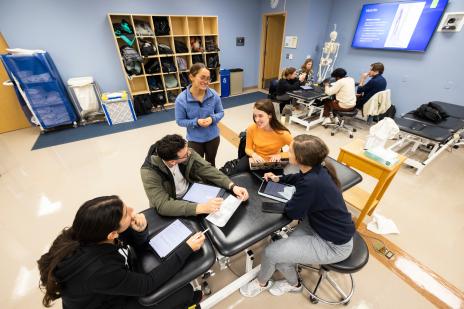
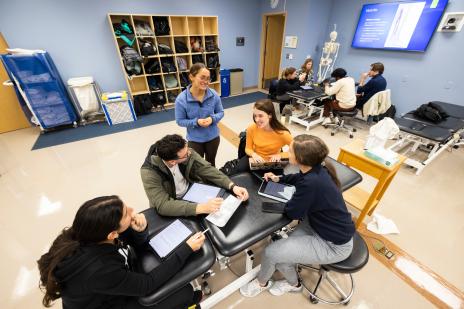
Ranked top in the state and nationally recognized for its DPT curriculum, the physical therapy program at UM-Flint attracts students who are eager not only to learn the profession, but to really entrench themselves in the Flint community through research and volunteer work.
“Flint and the Genesee County area are near and dear to our hearts,” Blackwood said. “We are here as the only physical therapy program at the University of Michigan to make a difference in this community. And we’ve made incredible differences.”
Supporting the future ‘Leaders and Best’
Rebecca James (College of Health Sciences Class of 2024, School of Management Class of 2023) serves as a graduate student research assistant working with chronic stroke patients and hopes to open her own practice one day.
“The idea of healing through movement is very powerful to me,” James said. “Combining that passion with my passion for helping people led me to where I am today.”
James also has donors to thank as part of her journey to becoming a doctor of physical therapy. As a recipient of the Frances Frazier Student Travel Award, Bradley Roth Memorial Scholarship, and Coleman J. and Lois R. Ross Jr. Scholarship, James was able to conduct research and present her findings at a conference held by the American Physical Therapy Association.
“It’s allowed me to take the time to make sure that I am getting the best out of my education, and I’m fully dedicated to my school work,” James said.
For Abigail Simone (BS ’16, MS ’17, DPT ’22, College of Health Sciences PhD Class of 2025), choosing UM-Flint was an easy decision, having earned two degrees from the Ann Arbor campus before coming to the dual DPT-PhD program. Supported by the Bradley Roth Memorial Scholarship, Simone is a current PhD candidate at UM-Flint, while also practicing as a physical therapist in Royal Oak.
This scholarship, Simone said, is helping her chase her childhood dream.
“Health care is something I’ve wanted to do since I was little, and I’ve never stopped battling for this dream,” Simone said. “But for a lot of people, they don’t follow through with it because of the expense. Having financial support makes that large amount of money seem less daunting.”
Second year DPT student Desiree Frantum (College of Health Sciences Class of 2025) holds the physical therapy profession close to her heart. From her own experience with treatment to working as an aid in high school to eventually working in acute care and treating her ailing grandmother before she passed away, physical therapy has played an important role in Frantum’s life.
“I just want to improve and impact a patient’s life the same way it has impacted me, whether that’s financially, physically, or professionally,” Frantum said. “We’re all human. We’re all going through something. And I believe the best way to deal with it is to get physical.”
A recipient of the Coleman J. and Lois R. Ross Jr. Scholarship, Frantum conducts research on physical therapy student caseloads, volunteers regularly at the HEART clinic, and one day, plans to explore women’s health and pelvic floor therapy.
Committed to sustaining the program’s legacy for decades to come, Blackwood attributes the growth of the program and the success of its students, largely, to support from donors.
“Students are still in a level of debt that is extraordinary and overwhelming to them. Any philanthropic support that we have from our alumni is extremely valued,” Blackwood said. “It enables them to make an incredible impact during their time here on campus.”