

By Ann Marie Aliotta | Photo by VP Communications, Regents of the University of Michigan
Domenico Grasso’s (PhD ’87) appointment as interim president of the University of Michigan this past May could be seen as a full-circle moment. He started his U‑M tenure in the 1980s as a determined and enterprising Ph.D. student, studying environmental engineering. Along the way, he met his future wife, Susan, in a graduate engineering class. He went on to a distinguished career as an educator and academic leader, returning to U‑M as chancellor of UM-Dearborn in 2018. Throughout his career, he has focused on innovation, diversity of thought, and student success. At Smith College, he was the founding director of the Picker Engineering Program, the first engineering program at a women’s college. And at UM-Dearborn, Grasso oversaw the tripling of external research funding that allowed the campus to achieve R2 status.
Called a “visionary leader” who will “help us all live up to the promise of leaders and best” by Board of Regents Chair Katherine E. White, Grasso approaches his new role with optimism and enthusiasm. “I offer my gratitude to the board and my promise to the community to meet this opportunity with energy, integrity, and dedication to our shared mission,” he told the board on May 8. Leaders & Best asked him about his main goals for his time here and the importance of philanthropy in U‑M’s mission to serve.
You’ve been in this new role for a few months now and have started with tremendous momentum. Tell us about your vision for your time here and what will be your main goals?
The overall excellence of the University of Michigan is unrivaled. From academics and health to intercollegiate athletics and public service, no other university excels in so many ways. It is a great privilege to lead such an extraordinary institution.
As president, providing stability and building trust are critical. I pledge to be visible and to unite with our faculty, students, staff, alumni, and donors to broaden Michigan’s impact.
These are challenging times for many essential institutions in our country, including higher education. There is skepticism and mistrust. While I believe much of it is without substance, I also believe we must work harder than ever to show—not just tell—how we make a positive difference. We do this through quality health care, engaging education, and a stimulating environment.
I want the university to expand access and opportunity efforts for all members of our community, as well as prospective students and scholars.
I also want to encourage greater civility and deeper discourse about complex issues as we approach the fall semester. We have the potential to serve as a model for higher education in managing the hard, sometimes bitter, conversations taking place on our campuses.
In everything we do, I want the University of Michigan to demonstrate its value and service to the greater world.
You were a big part of the campaign planning process, both as chancellor of UM-Dearborn and as a member of the Campaign Planning Group, which is a group of university leaders that provide counsel on our campaign strategy. Now, as president, can you share your thoughts on the campaign priorities and what importance they have for you?
Our campaign priorities align with our Look to Michigan vision. As the most comprehensive and distinguished public university in the world, U‑M bears a profound responsibility not only to lead in scholarship and innovation, but also to serve as a thoughtful compass in challenging times. Our campaign supports this commitment.
Our university is a place where bold ideas, transformative research, creative endeavors, and the education of tomorrow’s leaders come together in the public interest. We have set an aggressive campaign goal of $7 billion because society looks to our university for answers, solutions, cures, and treatments.
Philanthropy plays a critical role in our mission to serve society, whether with scholarships and fellowships for student success, endowed chairs for scholars, or visionary support for the most advanced laboratories, classrooms, residence halls, and cultural facilities in higher education.
We’re about to launch Life-Changing Education as the theme for the upcoming academic year, highlighted by special events, programs, and more. Why is this theme so significant, and relevant, to the University of Michigan and to the campaign? How does it align with what is important to you?
Anyone who has attended U‑M understands the impact of the learning experience. We have world-class faculty who help students explore, interpret, and challenge the world around them.
It’s critical to remember that a Michigan education is not limited to students’ time in classrooms and laboratories. Our graduates leave campus for myriad careers, all shaped by their experiences at U‑M. The impact is unending.
You have already been connecting with our donor and volunteer community. What are your impressions of these individuals and what does their support mean for U‑M?
Michigan alumni and supporters are a tremendous asset. They are our best ambassadors because of their diverse contributions to society and their presence throughout the world. And like a wolverine itself, they’re fierce about their dedication to the institution.
We’ve all experienced the instant camaraderie that comes with passing someone on the street who is wearing the Block “M.” The bond and the pride are immediate. And that is evident in philanthropic support for our students, faculty, and staff. Our donors believe in our mission; their gifts are a tangible demonstration of their faith in what U‑M can and will do to advance the human condition.
How do you see yourself further engaging with the campaign and philanthropic efforts?
My wife, Susan, and I are donors, and we both look forward to meeting with our supporters this fall, whether at football games, campus gatherings, or events in Ann Arbor and around the country. I always love sharing news about what’s happening on campus, as well as learning about our donors’ passions for U‑M. There is never a lack of engaging conversations and ideas.
Related Stories
Tags
Related Funds
The President's Fund - 419049
This fund, also known as the University of Michigan Annual Fund, helps to shape U‑M today and tomorrow by providing criti
Related Stories
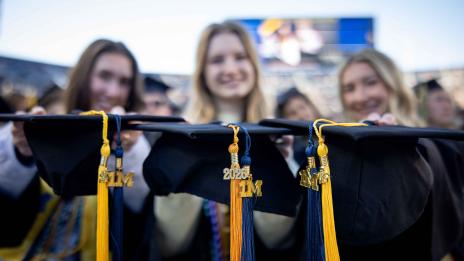
Caps, cords, and celebrations
Hats off to the Class of 2026! Here’s an inside look at eight graduation ceremonies around campus.