By Eric Gallippo | Art by Dyanna Bateman
There’s no major marker or placard on the University of Michigan campus commemorating the work of the Black Action Movement, but its legacy still lives today through the work of the Office of Academic Multicultural Initiatives (OAMI).
Frustrated and appalled by recurring racist incidents on campus in the late 1980s, students from the Black Action Movement III (BAM III) and United Coalition Against Racism (UCAR) protested U‑M’s response and demanded sweeping changes from the Board of Regents in 1987. OAMI was born out of that activism and call for social justice and, 35 years later, is still working to foster a diverse campus community and ensure all students thrive at U‑M.
“Our mission of supporting student academic success and promoting multiculturalism across our campus to create a community of belonging, it all goes back to those students who sacrificed and advocated for change here at U‑M,” OAMI Director Rachel Dawson said.
From recruiting students to building leaders
From its original focus on pre-college initiatives and student recruitment to a more recent shift to coaching, academic support, and student success—with an emphasis on developing leaders—OAMI has touched the lives of thousands of students. Current university leaders like Donald R. Shepherd Director of Athletics Warde Manuel; Associate Vice Provost, Deputy Chief Diversity Officer, and Director of Implementation for the Diversity, Equity & Inclusion Strategic Plan Katrina Wade-Golden; and Alumni Association President and CEO Ayanna McConnell credit OAMI with helping them become who they are today (Manuel and Wade-Golden as staff and McConnell as a student).
Under the early direction of the late Dr. John Matlock (AM ’73, PhD ’78), OAMI introduced scholarship programs and research initiatives to promote diversity on campus. In the 2010s, the office’s mission pivoted under Director Gloria Taylor toward providing students with tools to navigate campus and succeed after graduation.
For Taylor, making that switch in response to student needs was a highlight of her tenure and a natural evolution.
“If you have the role of recruiting underrepresented students, that role continues once those students are on campus. And so you get involved with just how well they are able to navigate the resources on campus,” she said. “They come to see you, and they tell you about their spirits. And so it was sort of a natural way of continuing that process from being involved with recruiting the students to doing it more in a formalized way of trying to see just how well the students are doing in the environment that you recruited them into.
"As a previous admissions counselor at the university, I was interested in student success once they enrolled on campus. Transitioning from primarily pre-college focus to academic success for enrolled students was a natural way of continuing the process."
‘What you need, you already have’
To aid them in that environment, OAMI began offering mentoring and study help, peer groups, and cross-cultural experiences for underrepresented students, including racial minorities, first-generation students, and transfer students.
Dawson said OAMI has led the way when it comes to academic coaching and working with underrepresented populations.
“OAMI really built that model, and it serves as the model for other schools, colleges, departments, and units entering that space across campus,” Dawson said. “You see a lot of that now, but OAMI has always been at the forefront, focused on holistic student success—to really sit down with students and work with them to say, ‘What you need to succeed, you already have. We just need to help you understand what that is, so that you can apply it to every aspect of your life.’”
Removing the plastic
In addition to academic success, OAMI’s mission is to build community—the word “family” gets used a lot—especially in a post-Covid atmosphere where students are still getting used to gathering. Its colorful, inviting office serves as a gathering place for students to drop in and share with each other and staff, take part in a game night, or enjoy some free food and socializing. Dawson said listening to students and letting them take ownership of OAMI is central to its mission.
“We have got to get away from that mentality of ‘If you build it, they will come,’” she said. “No, you need to let them help you build it. Letting the students guide and direct our work and centering their voices is really important to how we are going to move forward as a group.”
To use an analogy, Taylor said that "back in the day" people might remember the front room in their parents’ or grandparents’ homes, where the furniture was wrapped in plastic and uncovered for special guests or relatives. She feels too many students see the university like that room; they are reluctant to take a deep dive into all that it offers because they think many resources and experiences are reserved for other students.
“Over the years, OAMI has been instrumental in helping students remove the plastic covers to enable students to experience the deep and rich textures of the university's experiences and develop a sense of ownership, so they put their feet on the coffee table,” she said.
‘I could just be my natural self’
After struggling to find his way early in his college career, alumnus Keion Harris (AB ’23) said connecting with OAMI helped give him the confidence and community he was seeking on campus. Harris, a community college transfer, got involved with OAMI programs designed for transfer students and men of color who want to make a difference in their community. Today, he’s back on campus working toward his Ph.D. in social work and developmental psychology.
“Being introduced to OAMI really gave me a sense of confidence that I could do really well here, because I was able to find pockets of different communities where I was able to not only benefit myself, but also benefit other communities,” Harris said. “It was always just a great time and a safe space where I could just be my natural self.”
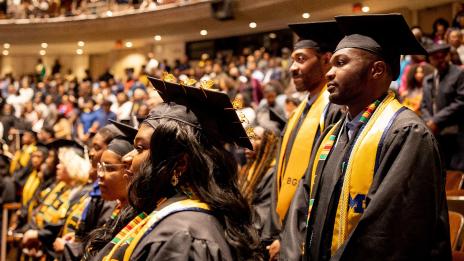
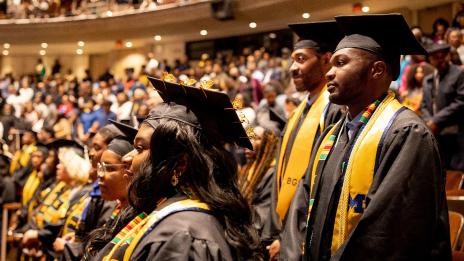
OAMI celebrates diversity more formally through events like its annual Martin Luther King Jr. Symposium in January and several cultural graduation celebrations held each May. A celebration of its 35th anniversary is planned for March. Last year, Harris took part in the Black Celebratory graduation ceremony, in addition to his departmental graduation and the big ceremony at Michigan Stadium.
Supporting diverse voices
At U‑M, philanthropy is vital for the university to maintain its commitment to championing diversity, equity, and inclusion on campus. Gifts to OAMI help the office support a wide range of initiatives, including programs that create a strategic path to college for non-traditional students, assist transfer students with their successful transition to U‑M, and celebrate diverse cultural traditions, among many others.
When it comes to supporting OAMI’s work, Dawson said it’s also about diversity beyond campus.
“Philanthropy for us is crucial, and there are so many reasons for donors to support OAMI,” she said. “For example, when you look at the state of Michigan and our percentage of college-educated graduates coming back and contributing to the growth and enhancement and development of their communities, U‑M plays a crucial role in that, and we’re contributing to that, with the help of philanthropy. Yes, we serve underrepresented minorities, but the largest group of students we probably serve are first-generation students, and they're coming from all walks of life and from all over our state.”
Getting accepted to the Ford School of Public Policy was a dream come true for first-generation college student and alumna Cortney Sanders (MPP ’17). Still, when she got to Ann Arbor, Sanders was glad to find resources that helped her succeed at U‑M.
“Not only was I going into a big pool of people, but I didn't know where to start or where to go,” Sanders said. “The student services were there to help me.”
“On campus, the obvious thing is that we support a well-balanced college population, but we also support important and diverse perspectives and views and visions for our nation,” Dawson said. “So there are many reasons people care about this work and touch this work and can connect with this work.”