
Katie Kazakos, Michigan Medicine
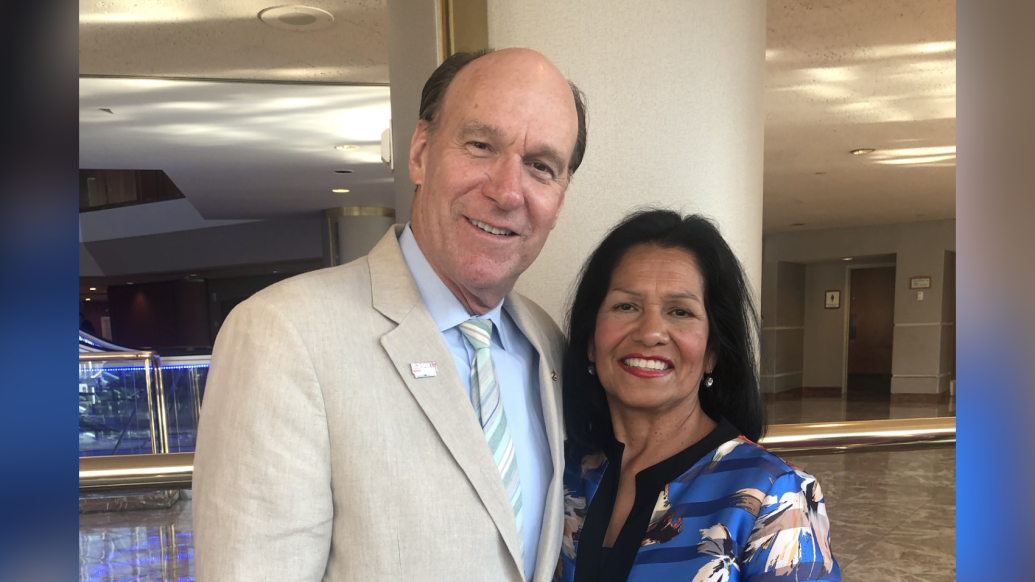
Christopher Harner (M.D. 1981) and Cynthia Martinez-Harner (A.B. Ed. 1977) have created two scholarship funds — one in the U‑M Medical School and one in the U‑M Marsal Family School of Education.
With these gifts, their goal is to open doors to opportunity for students from modest backgrounds, ensuring that talent, drive, and potential are not limited by financial barriers.
A legacy of education
Harner was raised in a family of educators, with both parents and one of his brothers pursuing careers in teaching. He earned a Bachelor of Science degree in zoology from Michigan State University in 1976 and was admitted to the University of Michigan Medical School in 1977.
During his third year of medical school, Harner met Martinez through mutual friends, a wonderful moment he describes as “getting hit by a lightning bolt.”
Like Harner’s family, Martinez shared a passion for education. She graduated from the University of Michigan School of Education in 1977 and embarked on a rewarding career as an elementary school teacher.
After earning his medical degree, Harner became a leading orthopaedic surgeon specializing in orthopaedic sports medicine and subspecializing in traumatic and degenerative knee injuries. He also ultimately followed in his family’s footsteps, becoming a respected educator at the University of Pittsburgh School of Medicine and later mentoring U‑M Medical School students.
Harner and Martinez-Harner are loyal Wolverine sports fans and the proud parents of three children. As their kids were growing up, Harner was known as the resident neighborhood doctor for scrapes and broken bones. Their daughter, Nina Harner, also attended U‑M, graduating in 2015 from the School of Kinesiology. She is continuing the family legacy of education through her work as a nurse education coordinator at Northwestern University Hospital in Chicago.
From East Lansing to Ann Arbor
Harner credits his East Lansing roots for helping to shape his path.
“My mom, dad, aunts, uncles, and cousins all went to Michigan State University,” he says. “There were four boys in our family, and since my parents were public school teachers, we had to pay our own way through college. The math was simple — we all went to Michigan State. I played baseball there and received a great education.”
After graduating from MSU, Harner entered the U‑M Medical School and immediately realized the importance of financial support for his medical education.
“When I was first looking for an apartment in Ann Arbor,” he says, “I knocked on the door of Fuller Apartments, and the person who answered was a third-year medical student. He asked if I was interested in being an assistant manager."
For the next two years, Harner filled the position and received free housing in return.
“I had to collect rent, ask people to quiet down or clean up — basically, the things an assistant manager does — but I had free rent for two years. That was a big deal for me and really helped cover my costs.”
He also received a small scholarship from a local bank in East Lansing. “I remember how significant that money was in helping with rent later on, food, car expenses, and things like that,” he says. “Looking back on my four years in Ann Arbor, that little bit of extra support was incredibly important. It made me think about other students in similar situations who would benefit from this kind of help while managing the rigors of medical school.”
Opening doors to a bright future
Harner also appreciates how the support he received from others opened doors to the benefits of attending a top medical school and ultimately changed his future.
“My classmates came from all over the country, and they were so diverse — that was really important,” he says. “And then as I went through the Medical School, I met so many teachers and mentors who influenced me. There were countless role models and opportunities.”
One opportunity that changed the course of his career was attending a visiting professorship lecture by Albert B. Ferguson Jr., M.D., then chair of the Department of Orthopaedic Surgery at the University of Pittsburgh, during Harner’s third year of medical school.
Harner spoke with Ferguson after his lecture and told him about his interest in orthopaedics.
“I think Dr. Ferguson liked me because I was a good student, played baseball at Michigan State, and then went to medical school at Michigan — I think he could see that I knew how to balance my time. He told me I should come to Pittsburgh.”
After earning his medical degree, he took Ferguson’s advice and completed his orthopaedic residency at the University of Pittsburgh School of Medicine. He then pursued his orthopaedic sports medicine fellowship in Salt Lake City, Utah, before being recruited back to the Department of Orthopaedic Surgery at the University of Pittsburgh.
Harner spent the next 35 years specializing in sports medicine and knee surgery and becoming a respected teacher and mentor of future orthopaedic surgeons. He estimates that he has educated over 300 undergraduate and graduate students, medical students, residents, and fellows.
Harner also served as team physician for the University of Pittsburgh, Duquesne University, the NHL’s Pittsburgh Penguins, and local high school sports teams.
Giving back and building a legacy
For the past several years, Harner has collaborated with the Medical School’s clerkship director to coordinate a one-hour session for prospective third-year medical students who have selected orthopaedic surgery as their intended specialty.
“The third year of medical school is a pivotal time for students and an ideal opportunity to discuss their potential future as orthopaedic surgeons and physicians,” Harner says. “I outline the educational pathway they will embark on over the next 12 years and emphasize the importance of early engagement and involvement. During this interactive session, I also address critical questions related to their upcoming applications and interviews. Most rewarding for me is hearing about their personal goals and aspirations to become orthopaedic surgeons.”
As a past leader of multiple orthopaedic professional societies, Harner also talks to students about the benefits of getting involved in organizations like the American Academy of Orthopaedic Surgery, the American Orthopaedic Association, and the numerous orthopaedic subspecialty societies. He shares how students can help shape the field through their involvement locally, nationally, and even internationally.
Harner met Alexa Wutt, assistant director of regional development in Michigan Medicine’s Office of Development, when she checked in to learn more about his mentoring. She was especially impressed by his dedication and commitment to students.
“It quickly became apparent that he is a natural teacher and humanistic physician who is deeply invested in the success of his mentees and the field of orthopaedic surgery as a whole,” she says. “I’m grateful to have the opportunity to work with him.”
Harner also draws from his unique insights and mentoring skills through his service on the Medical School’s admissions committee. His role is to interview prospective students as part of their application process.
Harner enjoys learning about the students’ backgrounds, including the challenges they have overcome and their hopes for their careers, and recognizes the importance of scholarship support for their future medical education.
“There are a lot of students coming out of undergrad and going into medical school with very large debt,” he says, “and medical school will create additional debts. This kind of financial support helps them not have to work an extra job or apply for student loans, so they can spend more time focused on their medical school education.”
In addition to the scholarship for medical students, a scholarship will also be established for incoming first-year students in the Marsal Family School of Education, from which Martinez-Harner graduated in 1977. Like the medical school scholarship, the education scholarship will support students from modest backgrounds who will face financial barriers while attending the University of Michigan.
“My hope is that someone chooses the pathway I did, which is medical education, research, and teaching,” Harner says. “I hope that continues. We need to have medical educators at all levels — undergraduate, graduate, residency, and post-graduate.”
Harner and Martinez-Harner are grateful for the opportunity to help talented students pursue their education at the U‑M Medical School and the Marsal Family School of Education.
“Michigan is especially important to me because it was a pivotal part of my career and my next step — it opened up countless opportunities,” Harner says. “That’s the great thing about the University of Michigan, and I don’t think that has changed. I feel very fortunate to have graduated from there and to have been a part of it, and that’s why I give back.”
If you would like to learn more about how you can support medical students, please visit the medical school scholarships giving page. Thank you for your support.
Related Funds
Tags
Related Funds
Dean's Scholarship Fund in the Medical School - 348010
Help provide vital scholarship awards to offset the high expense of medical education. As state and federal pressures
Marsal Education Student Scholarship Fund - 334567
This fund provides scholarships and financial aid opportunities to undergraduate and graduate students in the Marsal Fami