By Derek Smith | Photos by Marcin Szczepanski
This article was originally published in Michigan Engineering news.
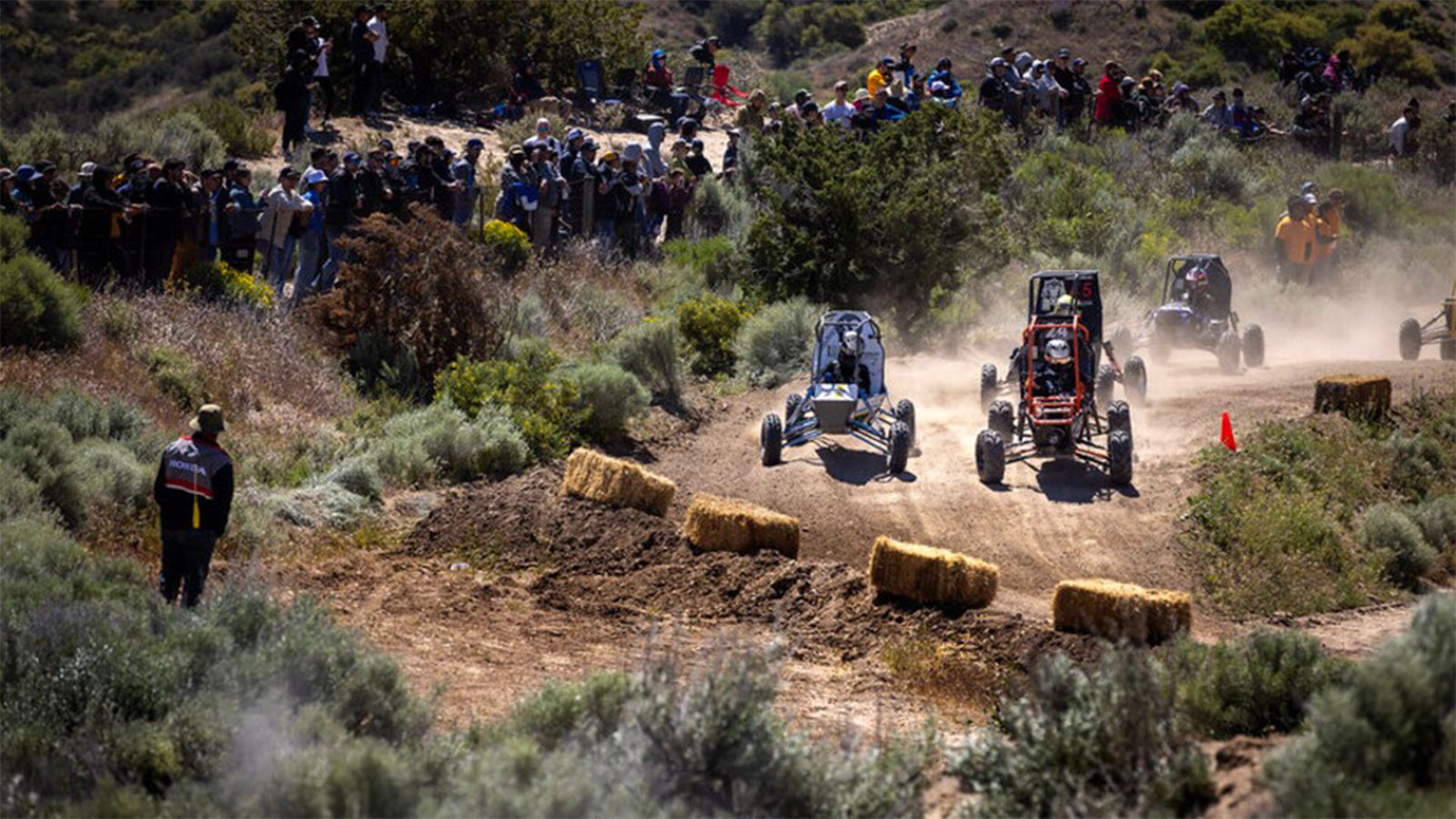
The four-wheel-drive clutch jammed as mechanical engineering undergraduate David Grover sped into the first sharp turn of the obstacle course at a 2024 Baja SAE International Competition, held at a dusty desert track near Gorman, Calif. in April 2024. Stuck in four-wheel drive, he was unable to drift smoothly through the turn, instead slowing sharply and taking it wide. The car's poor maneuverability cost valuable time, and every sharp turn after piled on more seconds as four-wheel drive's limited acceleration and handling sapped performance.
Hobbled by the transmission issue and a clogged gas cap that dampened acceleration, Michigan Baja ended up placing fourth overall. It was a disappointing outcome for a team that has placed among the top 3 Baja SAE International teams for the past 11 years. Their chance of winning the championship, which is determined by their performances at three different competitions throughout the year, was in jeopardy.
Afterward, there was nothing to do but head back to Ann Arbor and figure out how to move forward from the latest setback in a bumpy Baja season. But while the 2024 team faced its share of disappointments on the track, every setback was also an opportunity to learn, adapt and improve.
The hardships fueled teamwork, creativity, grit and empathy, which are among the leadership competencies that Michigan Engineering has identified as critical to student success. Michigan Engineering derived the competencies from surveys of faculty, students, employers, research by engineering educators, and recommendations by engineering accreditation organizations, and the College's experiential learning framework launched in 2022 to help students develop, track, certify, and reflect on the competencies.
For most students, the best way to hone these skills is with hands-on experience. The Wilson Student Team Project Center provides that experience, with 30 student teams housed in a well-equipped makerspace. The experience sparks innovation, camaraderie and experiential learning as students work day and night to build machines like off-road vehicles, solar cars, rockets, Mars rovers and electric boats. The projects inspire lifelong learning that keeps many students coming back year after year.
"I thought it was amazing that you could go from knowing absolutely nothing to being able to fully build a car," said mechanical engineering junior Simran Bagri, recalling her very first Baja meeting. "And so I stuck around."
A major challenge in Michigan Baja's 2024 season was honing its shift-on-the-fly four-wheel-drive system. The design inherited from previous years required an inordinate amount of muscle to switch between two- and four-wheel drive at high speed. The issue hadn't stopped previous teams from placing in the top three, but the team felt that the competitions were growing too close for comfort.
"We won by a hair last year . . . and going into 2024, we felt that was very reflective of the fact that our car had stayed the same for so long," said Grover, who was the rear gearbox lead for the 2024 car. "We needed to make the car more capable."
They hatched a plan to switch from a "dog" clutch that engages interlocking teeth to a friction plate system that would enable easier shifting. It was a risky step because the team had little experience with the new system.
"I knew every time we had to do something new there was a risk, but I'd rather take that risk than stay stagnant," said Pablo Elizondo Del Bosque, mechanical engineering junior and a continuously variable transmission lead. "If you copy and paste parts from last year's car, that's not going to make you an engineer."
The team hedged their bets by producing two clutches—both a new friction style and a revamped version of the previous dog clutch.
Design and production of the 2024 car began in August 2023 at the Wilson Center. The team used computer-aided design to optimize each part based on designs of previous Michigan Baja cars. An exercise in systems thinking, the process required subteams to work together to integrate each subsystem into a cohesive finished product.
In October, the team headed to the machine shop, where robotics junior and in-house manufacturing director Margaret Kempe led the production process. They manufactured 90% of the car—about 1,000 individual parts—on the Wilson Center's mills and lathes.
To build a car in time for the competition, the team not only needed to design for performance, but also for feasible manufacturing. To make it happen, the team's design and manufacturing teams communicated closely throughout the process.
"As a machinist, I don't necessarily know the design that's going to happen. Likewise, the designer doesn't necessarily know the capabilities of a machine, so it's just a balance of two different knowledge skills to actually produce something," Kempe said.
Production was finished in March 2024, but the friction clutch wasn't working as planned. With time running short, Grover and the team made the call to swap in the revamped dog clutch.
Another setback came a few weeks later, when a steep climb sheared one of the car's front axles in half just minutes into a test drive. The team had to call off the test and head back to the shop to begin work on a replacement. This curtailed any further testing of the new four-wheel drive system, with the California competition only two weeks away.
Bagri explained that when deadlines grow tight, empathy helped the team stay focused.
"To be successful as a team, you need to understand that people sometimes fall behind," said Bagri, who was also the team's external manufacturing director. "Rather than make them feel bad about it, you need to work with them to catch them back up."
Back at the Wilson Center, mechanical engineering senior Ian Beaufait led the subteam that quickly designed and manufactured a beefed-up axle. But there was a wrinkle: Axles require heat treating to improve their strength, and heat treating requires an outside supplier.
While the axle was being treated, the car's four-wheel drive system was out of commission, making testing and refining the system impossible. During stressful times like this one, Kempe said the team tended to draw on Lindblom's leadership skills, technical prowess and calm, cool demeanor.
"Linnea is a really powerful captain in the sense that she's super-confident in everything she says and does," said Kempe. "Everyone trusts that she knows what to do. When Linnea speaks, I know that we are going to have a car in time for the competition."
The shifting issues cost the team dearly in the California competition. Afterward, the team discovered that the gears in their clutch were binding too tightly because of the position of their shift fork—a metal lever that slides gears together to engage four-wheel drive. They were able to modify the fork to get their four-wheel drive system shifting smoothly for their next competition in Williamsport, Pa., two weeks after the California race.
But the four-wheel-drive issues left the team with less time to test the car's other subsystems, a problem that proved disastrous in the rough track conditions of the Pennsylvania race. The car's suspension failed three times, and every attempt at repairs made matters worse. Any hope of a 2024 championship was lost in Pennsylvania.
The team was disappointed by their performance in Pennsylvania, and not just because of the pressure to maintain a winning streak. Grover explained that simply getting a finished car to competition was a herculean effort, to which many of the students devoted most of their waking hours. But every setback was also an opportunity to learn, adapt and improve.
"You don't learn anything from doing well . . . so I think having this experience will make us even stronger," Grover said.
The team used the lessons learned from Pennsylvania to improve the car's suspension for the final Baja SAE International competition in Holly, Mich., which took place between September 12 and 15. The hard lessons from California and Pennsylvania paid off, and the team was able to finish the Michigan competition's endurance race without being towed off the track for repairs—a first for this season. The team placed 8th in the race, and 4th overall in both the Michigan competition and the entire year.
Learning how to extract value from failure and gain the grit required to solve tough problems is an important skill for an engineer, said Jeff Walker (BS ME ‘10). Walker was the Baja team captain in 2009 and is now the engineering manager for crate engines and performance parts at General Motors' Milford Proving Grounds. Fourteen years later, he still draws from the lessons he learned with Baja.
"You learn the customer base, how to talk with suppliers and design for feasible manufacturing. I learned all that stuff in the Wilson Center," he said.
"Engineers are full of ideas, but when you get in the real world, not all those ideas come to fruition. Something happens and you have to rework the idea. How you react to that situation is really important. Do you shut down, or do you continue to work at it and make something better next time?"