
By Madeline Swanson | Read time: 13 min
Key takeaways:
- The W.E. Upjohn Peony Garden is driving discoveries in sustainability, medicine, genetics, and conservation, serving as a living laboratory.
- U‑M researchers are tackling challenges right here at home—such as mapping plant chemistry and developing more sustainable fertilizers that reduce imports into the Great Lakes.
- For more than a century, donor support has advanced research, supported students, and helped to preserve this one-of-a-kind campus resource.
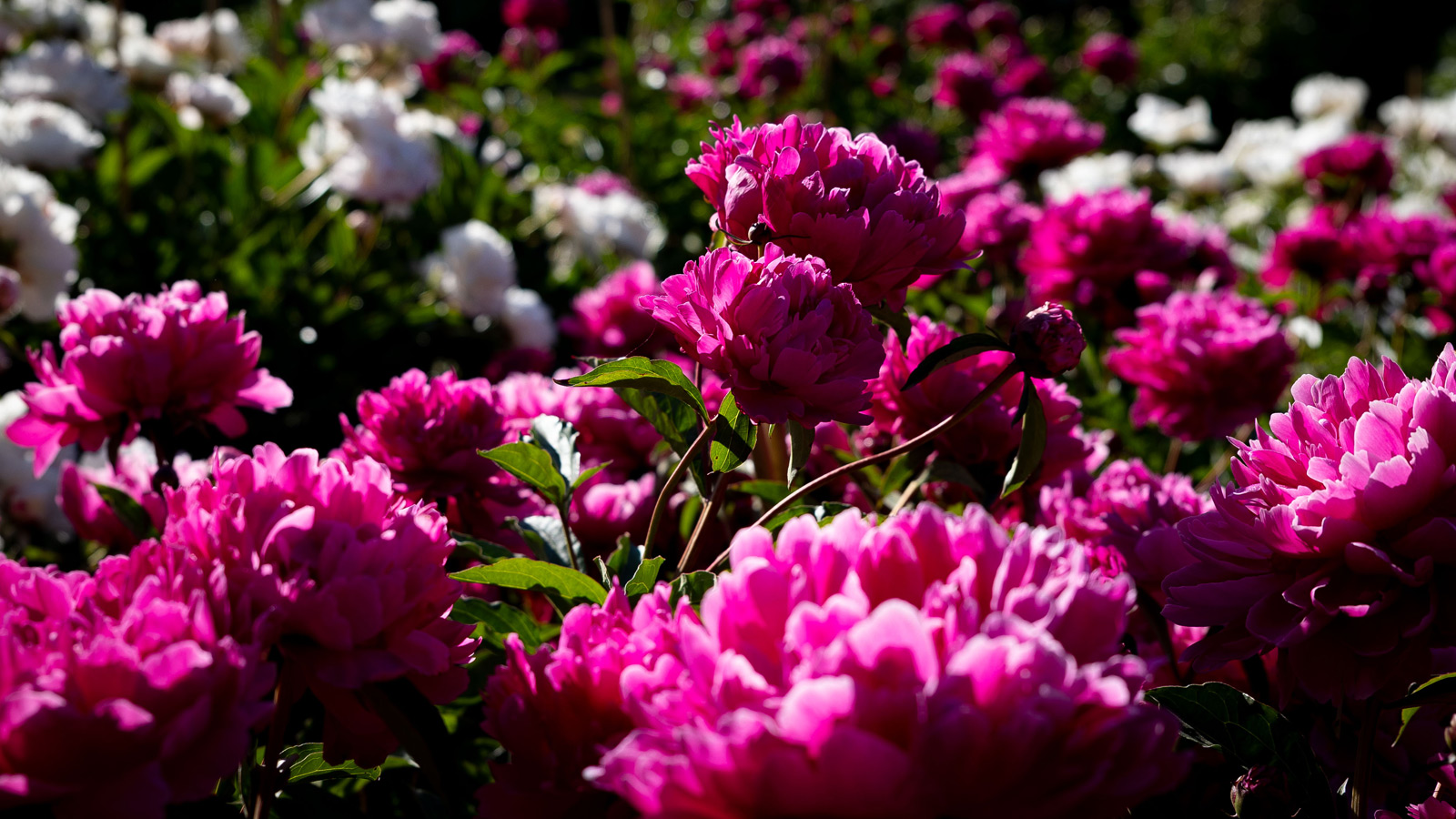
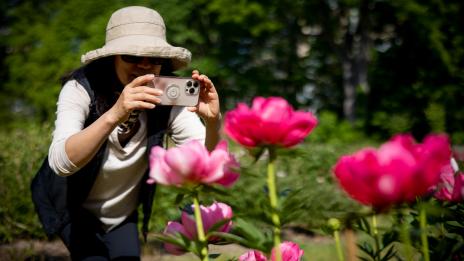
Each spring, the W.E. Upjohn Peony Garden draws visitors into one of the University of Michigan’s most beloved landscapes. Historic blooms open in shades of pink, white, crimson, and coral, boasting beauty that feels almost extravagant after a Michigan winter.
But the garden’s most powerful work is not always visible from the path.
Beneath the blooms is a deeper root system: rare and historic cultivars, over a hundred years of plant records, careful stewardship, donor support, and a growing network of U‑M researchers who see in the garden not only flowers, but questions. Questions about genetic diversity and disease resistance. About plant-based medicines and sustainable fertilizer. About conservation, resilience, and the future of living collections.
That root system began with philanthropy more than a century ago. W.E. Upjohn, a U‑M Medical School alumnus and founder of the Upjohn Pharmaceutical Company, gifted a collection of peonies to the university that today is still supported by donors.
“One of the unique strengths of Matthaei Botanical Gardens and Nichols Arboretum is our ability to connect research, teaching, stewardship, and public engagement in the same spaces,” said Anthony Kolenic, director, Matthaei Botanical Gardens and Nichols Arboretum. “As a living-learning laboratory for the university, researchers and students are able to explore real-world questions, while visitors have opportunities to engage with that work in meaningful ways.”
Reading the chemistry written in plants
The peony garden is part of a broader ecosystem of living collections at U‑M that also supports discovery in medicinal chemistry.
Roland Kersten, an assistant professor in the College of Pharmacy’s Medicinal Chemistry Department, studies natural products—chemical compounds produced by living organisms. Plants have a long history in medicine, inspiring treatments from pain management to cancer care.
Kersten’s lab is interested in what remains undiscovered.
“We’ve maybe characterized 5-10% of plant chemistry, but the other 90% is still unknown,” he said. “So how do you start analyzing that or how do you catalog that chemistry?”
One of Kersten’s larger goals is to create a “map” that could help researchers locate molecules and the pathways plants use to make them across the plant world.
Plants have evolved complex chemistry over hundreds of millions of years, often as a way to defend themselves from predators, disease, or environmental stress. That chemistry can interact with biological systems such as a disease-causing protein in powerful ways, making plants an important source of potential drug leads and useful enzymes.
Ph.D. student and Rackham Merit Fellowship recipient Gabrielle May works with plant specimens from Matthaei and other botanical gardens around the country. By weighing individual molecules to identify a plant sample’s composition, they generate searchable chemical data from diverse plants.
This data can help scientists understand relationships among plant groups, support conservation research, and find cleaner, more sustainable ways to manufacture medicines.
“Enzyme chemistry is really growing currently,” May said. “There's a lot of research going into how we can create the chemicals that we need for society using enzymes, rather than more traditional synthetic methods. … That could have big impacts for sustainability and cleaner ways to manufacture things.”
Pee for the peonies
While some researchers look inside plants for hidden chemistry, Nancy Love looks at what feeds them—and what society throws away.
Love studies water quality, wastewater systems, and nutrient recovery. Her work addresses a simple question: What if communities stopped treating valuable nutrients as waste?
At Michigan, her team is turning human urine into fertilizer products—a collaboration between the College of Engineering and Matthaei called “Pee for the Peonies.” The process makes the material safe and usable so the nutrients can be recombined into different ratios depending on the needs of particular plants.
“The impact is to improve nutrient efficiency. … It’s good to have alternative options for fertilizers,” said Love, the Borchardt and Glysson Collegiate Professor and JoAnn Silverstein Distinguished University Professor in the Department of Civil and Environmental Engineering.
At the peony garden, selected plants receive urine-derived fertilizer, while paired plants are left untreated for comparison. The project is scientific, but it is also public-facing. They offer a tangible way to talk with visitors about nutrient cycles, sustainability, and circular systems—turning otherwise invisible infrastructure into something people can see.
Right here in Michigan, the implications are important, according to Love.
“In just the Great Lakes alone, we import NPK (nitrogen, phosphorus, potassium) to support our agriculture and our horticulture and our yards,” Love said. “All of it is used once and then goes right back into the environment. If most of it was used twice, we can reduce what we import into the Great Lakes region, and that alone is an example of nutrient efficiency.”
For Love, the long-term possibilities extend beyond the garden beds. Additional funding can make nutrient recovery systems more visible at Matthaei, support educational programming, and help reduce imported fertilizer use.. The work aligns with a larger vision of campus as a living-learning laboratory—a place where sustainability is not only studied, but demonstrated.
“I believe that if by the end of the century we want to have more sustainable water systems and more regenerative nutrient systems, we need early adopters now to start giving people experiences of what circularity looks like to normalize it,” Love said.
Beneath the bloom: genetics, disease, and resilience
For Liliana Cortés Ortiz, an associate professor in the Departments of Ecology and Evolutionary Biology and Anthropology, and Nastassia Vlasava, a research specialist in the Cortés Ortiz lab, the peony garden offers a glimpse into the future.
With more than 10 years of collaborative research with MBGNA and Curator David Michener, their work focuses on the genetic and genomic diversity held within the collection, as well as what that diversity may reveal about plant resilience. By studying the DNA of historic cultivars and their ancestral wild peony species and other collections, the team hopes to better understand the domestication drivers of peonies, origins, and relationships among the garden’s plants. The research could help scientists and growers better understand how cultivated plants adapt, resist disease, and retain the evolutionary potential needed to survive future environmental change.
“It’s exciting to observe that some plants of different or even the same cultivars still remain healthy [even though] nearby plants are full of viruses,” Vlasava explained.
This work is foundational, but its implications are broad for horticulture and environmental conservation, Cortés Ortiz said. Because climate change is making future growing conditions unpredictable, preserving genetic diversity helps plants adapt to new environmental pressures, helping growers make more informed decisions about which plants to preserve, propagate, or cross-pollinate.
Curating a century of living history
At the peony garden, its records are part of what allows beauty to become knowledge.
For Rachel Gosch (MSI ’21), head of collection services at the University of Iowa Law Library, the garden presented a different kind of research question: How do you preserve more than a century of living history so future researchers can use it?
Since these records existed across physical and digital formats with little standardization.
Together with Andrea Thomer, associate professor at the University of Arizona College of Information Science, Michener, Cortés Ortiz, and Vlasava, Gosch helped develop a framework to organize and preserve the garden’s diverse records. Her team piloted the plan using an initial set of records from roughly the past decade, helping reduce the risk of data loss and making the information more usable for future research. The broader schema will also integrate new genetic and morphological data for each plant in the garden that can be cross referenced with historical records.
With over 100 years of records describing U‑M’s peonies, Gosch said she’s “glad that our work could save data for future researchers and serve as a preservation model for other unique data sets.”
Data curation may be quieter than counting blooms or studying plant chemistry, but it is essential to the garden’s role as a living laboratory. Just as horticulturists tend the plants themselves, information scientists help tend the records that allow the garden’s scientific and historical value to live on.
Philanthropy is perennial
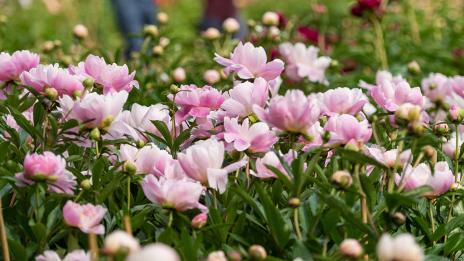
The W.E. Upjohn Peony Garden is a living example of how philanthropy can grow and regenerate at Michigan. In 1922, W.E. Upjohn gave a gift of peonies that would become the University of Michigan Nichols Arboretum Peony Garden. A century later, Upjohn’s family donated $2 million to the university, and in recognition of their generosity, the Board of Regents named the garden in Upjohn’s honor.
Nearly 100 years after his original gift, Upjohn’s granddaughter, Martha Parfet (LSA ’46) gave $500,000 to ensure the peony garden would flourish long into the future—the largest endowment ever to Matthaei Botanical Gardens and Nichols Arboretum.
Numerous donors support the peony garden and the research being done there. For students like May, it’s this philanthropic support that has allowed her to focus on her research without worrying about funding for her work.
The garden’s value is not limited to the weeks when it flowers. Its deeper impact grows year-round—it cultivates innovation in laboratories, classrooms, public conversations, and collaborations that stretch across disciplines.
“I see the contribution of all these donors to maintaining and to improving the garden is not just for the enjoyment of few, but also for the learning of many,” Cortés Ortiz said. “It’s a symbol of pride in Ann Arbor, but also it’s an iconic place that if we can transmit the value beyond just the beauty, but the value as a resource for research—as a resource for knowledge for the public in general, I think that is an added value beyond the plants.”
Each spring, visitors will flock to the peony garden for its beauty, but beneath it, the roots are hard at work. Holding history, advancing discoveries, and with support, sprouting new blooms of knowledge for generations to come.
Related Funds


Related Stories



Tags
Related Funds
W.E. Upjohn Peony Garden Fund - 796538
In 1922, W.E. Upjohn provided U‑M with a critically evaluated and large collection of herbaceous peonies, which marked th

MBGNA Director's Discretionary - 314966
Your gift to this unrestricted fund will support critical areas and projects at Matthaei Botanical Gardens and Nichols Ar

Botanical Gardens and Arboretum Membership - 310447
Your gift to this unrestricted fund will help support many Matthaei Botanical Gardens and Nichols Arboretum as determined
Related Stories
U‑M Peony Garden named after W. E. Upjohn 100 years after his original gift
In 1922, W. E. Upjohn gave a gift of peonies to U‑M that would become what is now the Nichols Arboretum Peony Garden.
5 tips to grow your garden
U‑M’s Campus Farm Program Manager Jeremy Moghtader talks about sustainable food sources and how you can create a flour

Go bloom
A legacy gift ensures healthy future for peony collection at Matthaei and Nichols.

A natural connection
New trails connect green spaces in and around Ann Arbor.

Where the community grows
The Gaffield Children's Garden at Matthaei Botanical Gardens is a vibrant space where children, families, and students