

By Madeline Swanson | Photos by Marc-Grégor Campredon and VP Communications, Regents of the University of Michigan
Every Michigan story begins with a student. The Year of Life-changing Education, the university’s theme for the 2025–26 academic term/year, shines a light on how learning transforms lives—not in the abstract, but in classrooms, in labs, in communities across the state and beyond—and how donors are contributing to this effort.
From access programs that open new pathways, to research opportunities that ignite curiosity, to volunteer experiences that make real-world impact, students are experiencing education in ways that prepare them not only for careers, but for leadership and service in a rapidly changing world.
At a moment when higher education’s value is being debated in living rooms and legislative halls, the University of Michigan sees an opportunity to demonstrate what life-changing education means and to invite others to help shape the future of learning itself.
“The world is changing rapidly: artificial intelligence, technological and scientific advancements, environmental and health concerns, societal change, global conflict, and challenges to democracy are just some of the dramatic changes in the current moment,” said Marsal Family School of Education Dean Elizabeth Moje, co-chair of the theme year. “Education is at the very core of addressing all of the challenges in human existence.”
Show, don’t tell
So how does one “show, not tell” the world what life-changing education looks like in a rapidly evolving landscape? This year’s approach unfolds across four areas:
Open inquiry
In an era of polarization, Michigan is doubling down on dialogue. Open Inquiry Week, which ran October 6-9, brought distinguished voices to campus for conversations across differences. The newly launched Talking Maize and Blue app gives every first-year student a chance to practice curiosity and respectful disagreement—whether it’s about pizza toppings or freedom of speech. “We’re committed to making ‘open inquiry’ more than a slogan,” said Angela Dillard, vice provost for undergraduate education and a co-chair for the year’s programming. “We want our students and our communities to experience it and grow from it.”
Expanding access
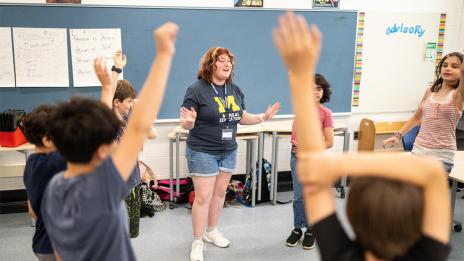
Dillard also believes opportunity must be as ubiquitous as talent. Through programs like Wolverine Pathways, the Center for Educational Outreach, and the College of Literature, Science, and the Arts’ Intend to Attend, U‑M aspires to forge deeper connections with K-12 schools across the state, and to develop stronger partnerships that open doors for more students—whether they end up on the Ann Arbor campus, at UM-Dearborn or UM-Flint, or elsewhere in Michigan. “Our goal is to build a culture of college readiness, whether it’s working with schools, families, and young people to build capacity, or through programs like the Michigan College Advising Corps that send our own recent U‑M graduates to high schools across the state to serve as counselors and advisors for students where the need—and the potential impact—is greatest,” said Dillard, who is also serving as interim vice provost for access and opportunity.
Campus of the future
This winter, a design competition will invite students and faculty alike to reimagine what a future campus—physical and digital—could look like. Participants will be invited to answer the question, “How will technology, AI, human connections, and well-being shape learning spaces to come?” Mike Solomon, dean of the Rackham Graduate School and a co-chair of the theme year, believes, “Other universities can look to Michigan with confidence that we can create that future and that we can be in conversation with our communities to do that in a way that will really align with what we need in the next two decades, the next 50 years.”
Sharing scholarship
Michigan’s research is hitting the road. With a new ED Talks series—think TED Talks for education—scholars will travel from Ann Arbor to school districts across the state, bringing vital research on topics such as math education, educational policy, and educational justice directly to those districts. “Currently, there are more than 18,000 graduate students here that are pushing the envelope of human knowledge in service of our public mission, and that’s an exciting story to tell,” Solomon said. “We’re going into communities and engaging with them around their aspirations, and then showing how our research and engagement can impact that.”
“When it comes to the Life-changing Education theme, we are advancing life-changing education everywhere,” Moje said. “We are expanding and improving the learning experiences of U‑M students, but we are also leading and developing evidence-based, empowering, life-changing education opportunities for all as we embark on this journey together.”
Why now?
The decision to focus the 2025–26 academic year on education was no accident. For Solomon, the timing couldn’t be more vital.
“We see an opportunity not just to defend our value, but to connect with the public, statewide and beyond, about how deeply and practically the university can shape futures at every level: K-12, college, and in lifelong learning,” Solomon said.
For Dillard, the theme year reflects U‑M’s commitment to opening doors of opportunity and preparing the next generation of Michigan students to pursue their dreams. The theme year coincides with the growth of the U‑M Student Success Initiative, a cross-campus effort that seeks to ensure that every Michigan student graduates fully empowered with the skills and knowledge necessary to live fulfilling lives and to transform our world for the better at such a critical historical moment.
“I’m excited about the ways that the theme year allows us to think about the connections among the university’s past and our complex history; the nature of our present-day commitments to students and the joy of learning; and about our myriad hopes and aspirations as we move further into the 21st century,” she said.
Partnering with donors
Solomon believes donors are key partners and important conveners of new ideas and bold actions.
“I think of philanthropy as a kind of intersection of perspectives and ideas. Philanthropists come with their vision for the future and their willingness to talk with us so that we can meld ideas,” Solomon said.
“That is exactly, I think, what we mean by the campus of the future and engaging in the community. I think this just gives us an opportunity to do things that are new because of the cross-pollination that occurs when we talk with people who see needs from where they sit within their community and believe that working with the university can make a difference.”
Donors are encouraged to immerse themselves in the theme year by trying the Talking Maize and Blue app, attending an ED Talk, or meeting Wolverine Pathways students on campus. People can follow along throughout the year at the website.
Dillard said she hopes this theme year provides them with an “inside look” at some of the programs, causes, and events they support.
“We want donors to kind of get more insight into programs like Wolverine Pathways and the Student Success Initiative,” Dillard said. “For instance, people may have heard about Wolverine Pathways, but I think for a lot of donors, they may not really have much opportunity to get into the nitty gritty and to think about what’s happening when the university is out in communities working with seventh and eighth graders.”
That kind of engagement, leaders emphasize, goes beyond events and programs—it reflects a deeper commitment to education itself, something Moje sees as central to the university’s mission.
“Meaningful learning requires meaningful investment and transforming education around the globe requires transformational investment,” Moje said. “Our donors continuously demonstrate their commitment to advancing transformational education. They serve as proud ambassadors who share their personal stories that showcase the ways in which supporting education has an infinite impact.”
Education for life
The Year of Life-changing Education invites students, faculty, alumni, and community partners to explore what learning can be when it’s joyful, practical, and connected to real challenges.
“It’s not enough to lower the barriers to admission,” Dillard said. “We need to create ways for every student to belong, to grow, and to succeed—not just here, but in the world they’ll shape after they leave.”
Related Funds
.jpg)
Related Stories

Tags
Related Funds
Rackham Impact Fund - 364240
Gifts in this area support the academic scholarship, research, and creative work of Rackham graduate students at the m
Marsal Education Fund for Excellence - 364230
The Fund for Excellence is available to support the Marsal School's most pressing needs.
Detroit P-20 Marygrove Learning Community Impact Fund - 331820
This fund supports the Marsal School's critical work within the Marygrove Learning Community: a Detroit P-20 Partnership,
Related Stories
Caps, cords, and celebrations
Hats off to the Class of 2026! Here’s an inside look at eight graduation ceremonies around campus.
A new approach to teacher education
U‑M’s revolutionary Teaching School supports novice teachers in hopes of increasing retention rates and improving the

Schools of the future
Despite the problems facing education, Elizabeth Birr Moje, dean of the School of Education, believes that out of turb
New U‑M center seeks to make learning accessible to all youth
ANN ARBOR, Mich. – With a $14.7 million gift, U‑M alumna Eileen Lappin Weiser is establishing The Eileen Lappin Weiser
Carrying on the family tradition
University of Michigan alumni Jonathan and Kelly Opdyke were born and raised with Michigan in their blood and a love f
Teamwork in a time of crisis: How U‑M is partnering with Detroit to reimagine public education
Through a new collaborative partnership with the Detroit Public Schools Community District, Starfish Family Services,
Adding it all up
Two U‑M supporters elevate mathematics education in Grand Rapids-area schools.
The hidden power of algebra
New research and mentoring award honors Mel Hochster’s legacy and invests in the future of math research
Beyond the backpack
Marsal Family School of Education experts share advice for academic success for both students and parents.