
By Anissa Gabbara | Photos provided by the School for Environment and Sustainability
Imagine being in the middle of nowhere: having no phone service or electricity, experiencing 24 hours of daylight, and immersing yourself in the natural world and the wonders of the wildlife that surround it. These are just some of the simple pleasures of the Arctic—one of the most breathtaking places on Earth. And students at the University of Michigan School for Environment and Sustainability are working hard to protect it.
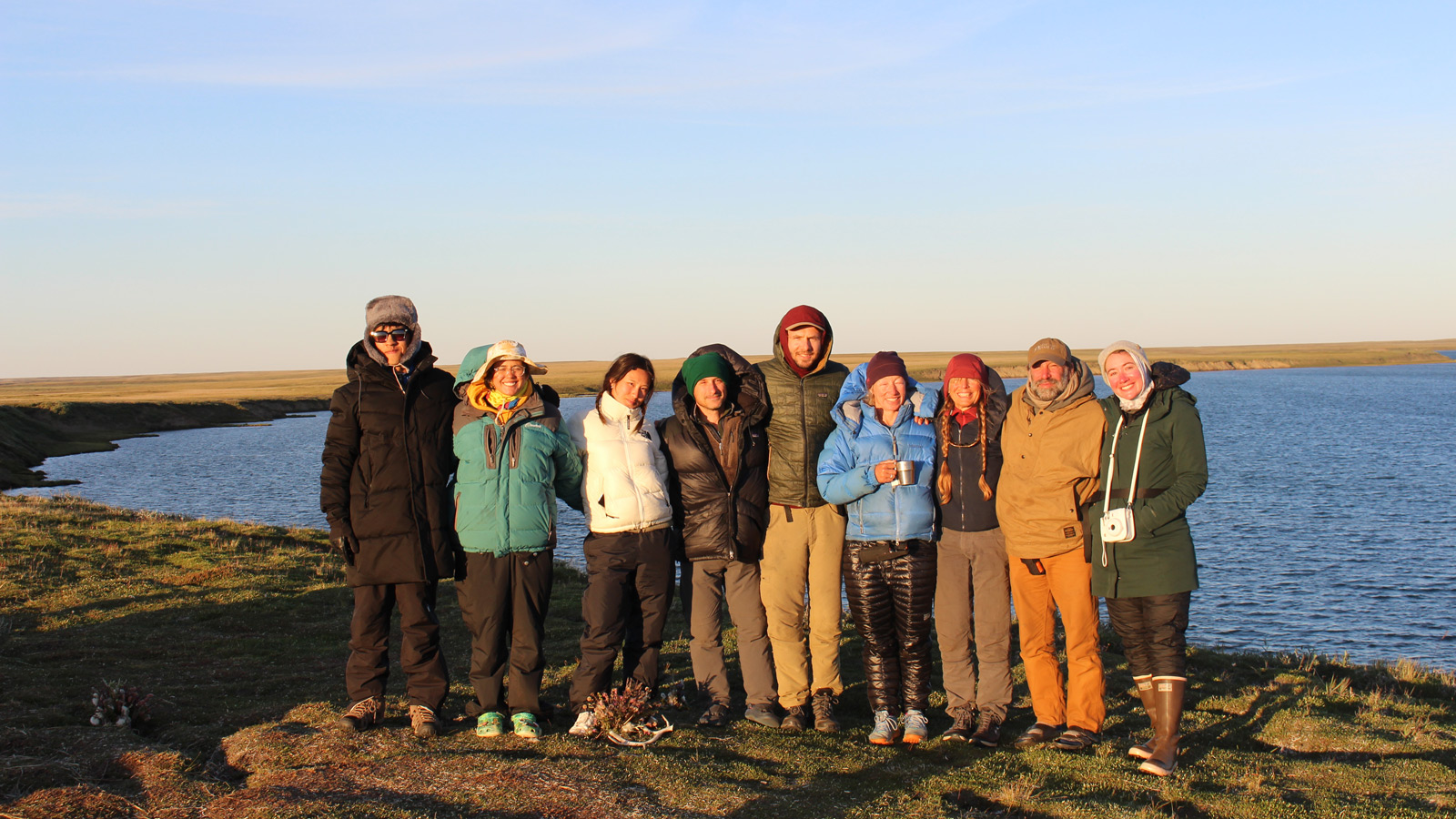
The summer 2025 Arctic expedition was one for the books. Funded by the NorthLight Foundation—a private foundation established by longtime U‑M donors Dan and Sheryl Tishman—which supports initiatives that strengthen conservation efforts and economic resilience across the U.S., the trip provided four SEAS students with direct field experience in the Teshekpuk Lake region, located in the National Petroleum Reserve-Alaska.
With a goal to understand the environmental threats that local landscapes and ecosystems are facing as a result of Arctic industrialization, the week-long experience connected students with advocates and field-expert guides to explore the region and create long-term projects designed to protect the area.
For the Tishmans, many years of philanthropic giving merged with an interest in land conservation and a dedication to preparing students to take on the challenge.
“The Arctic is among the planet’s most extraordinary and imperiled places,” Sheryl Tishman said. “Experiencing it firsthand brings a profound understanding of what’s at stake—and inspires the commitment needed to protect it. That’s why NorthLight is helping the next generation of leaders see and know this landscape for themselves.”
“There is constant pressure between preservation and commercialization, and we’ve been very interested in what these natural landscapes really mean, how important it is to save them, and what it is about them that we don’t know today that we would want to know tomorrow,” Dan Tishman added.
Real problems, extraordinary efforts
To understand why Arctic advocacy matters is to realize what’s on the line. According to environmental scientists, climate change is warming the region, thus thawing permafrost and emitting carbon, making a bad situation worse. Furthermore, oil and gas extraction releases greenhouse gases, another contributing factor to the climate crisis, disrupting ecosystems and harming wildlife. Additionally, the effects of climate change are impacting Indigenous communities that depend on the Arctic’s natural resources for survival. Plus, pollution from industrial activity poses significant health risks.
SEAS graduate Jean Poll Alva recognizes these challenges and is passionate about finding solutions. During the trip, Alva focused on monitoring permafrost in order to understand how different vegetation types and surfaces influence the depth of the active layer in the soil that thaws and freezes each year. To do this, Alva set up low-cost field instruments in areas with different ground cover to measure their depth. He said it was a small-scale effort, but it helped him realize how valuable even a small landscape can be, and how much potential there is for larger-scale monitoring in the future. Additionally, it made Alva think about how vulnerable these systems are as the ground warms, as well as the increasing pressure for new infrastructure development in the region and the potential economic trade-offs like infrastructure damage, methane release, and habitat loss.
“The goal would be to give policymakers and funders a clear picture of how climate and economic systems interact in the Arctic so the decisions about development can better account for long-term environmental goals,” Alva said.
With a background in business sustainability and policy, SEAS graduate student Yejin Kim is creating an optimization framework to help policymakers balance energy development, fiscal equity, and environmental protection across Alaska’s federal lands. Her project focuses on the National Petroleum Reserve-Alaska, where she is building a data-driven model to visualize how different land-use and revenue-sharing decisions affect both local communities and long-term public value. Kim said the idea struck her after studying the Reserve’s complex legal and economic history prior to the trip. Kim also realized that despite all the environmental work she’s done, she’s never been able to actually experience the places she was studying.
“It was mostly a vague concept of the environment, and all the impact that I could see from my work was numbers and reports. So for me, just getting to see the land geographically and spiritually connecting with the land has really motivated me to put much more work and effort toward my goal,” Kim said.
Investing in tomorrow’s leaders
The challenges around Arctic conservation are vast and complex, leading to rapid changes. But one thing remains: the region’s abundant beauty. It’s no wonder the Tishmans fell in love with the Arctic, having been there themselves. And sure enough, students who took part in the expedition would develop the same fondness, becoming what Sheryl Tishman describes as “informed, effective stewards of our shared future.”
“Part of the thrill of being able to have University of Michigan students going there is to see how they fell in love with the place after having only been there a week,” Dan Tishman added. “It stimulates incredible thought. It makes writers out of people who weren’t writers. It makes poets out of people who weren’t poets. And it’s a place where if nothing else, you can go to somewhat have your soul restored.”
Kyle Whyte, the George Willis Pack Professor at SEAS and Tishman Center for Social Justice and the Environment faculty director, stresses the importance of place-based education in helping students “build their own stories in places they love and want to devote themselves to protecting for the sake of future generations.”
While reflecting on the trip, Alva and Kim expressed their gratitude to the Tishmans for creating opportunities for students who are eager to gain a deep understanding of their fields.
“We all really appreciate the donors’ funding because I could never imagine that I would be able to participate in this big project without the support,” Kim said.
“Beyond funding logistics, though, donor support creates opportunities for growth,” Alva added. “It allows students to connect what they have learned in the classroom to the real world, to ask new questions, and to develop projects that can actually make a difference. It is not just an investment in education, it’s an investment in the next generation of environmental leaders who will carry these lessons forward.”
Related Funds
SEAS Annual Fund - 302341
Each year, 100% of the school's Annual Fund is used to meet urgent academic needs and enrichment of SEAS students.

SEAS Student Support - 322343
SEAS has a record of attracting the brightest students from all over the world. Their positive energy and thirst for know
Related Stories
Tishman family gives $11M for Social Justice and Environment Center
ANN ARBOR—The NorthLight Foundation and Dan and Sheryl Tishman have committed an $11.125 million gift to the Universit
L&B in conversation with Andrew Hoffman: At the intersection of business and sustainability
With Leaders & Best, professor Hoffman shared his thoughts on cross-disciplinary research, climate activism on cam

Climate action. Now.
U‑M’s charge to battle climate change, advance sustainability, and fight for environmental justice

Steps to a sustainable mindset
Experts from U‑M’s Planet Blue Ambassador program and Biological Station in northern Michigan share big ideas and smal
Saving our pleasant peninsula
Michigan’s great outdoors is being threatened by climate change. Here’s what U‑M researchers are doing to help track,

A conversation with U‑M’s VP for Research and Innovation
U‑M’s VP of Research talks about our most impactful projects and the tremendous breadth of our research enterprise