
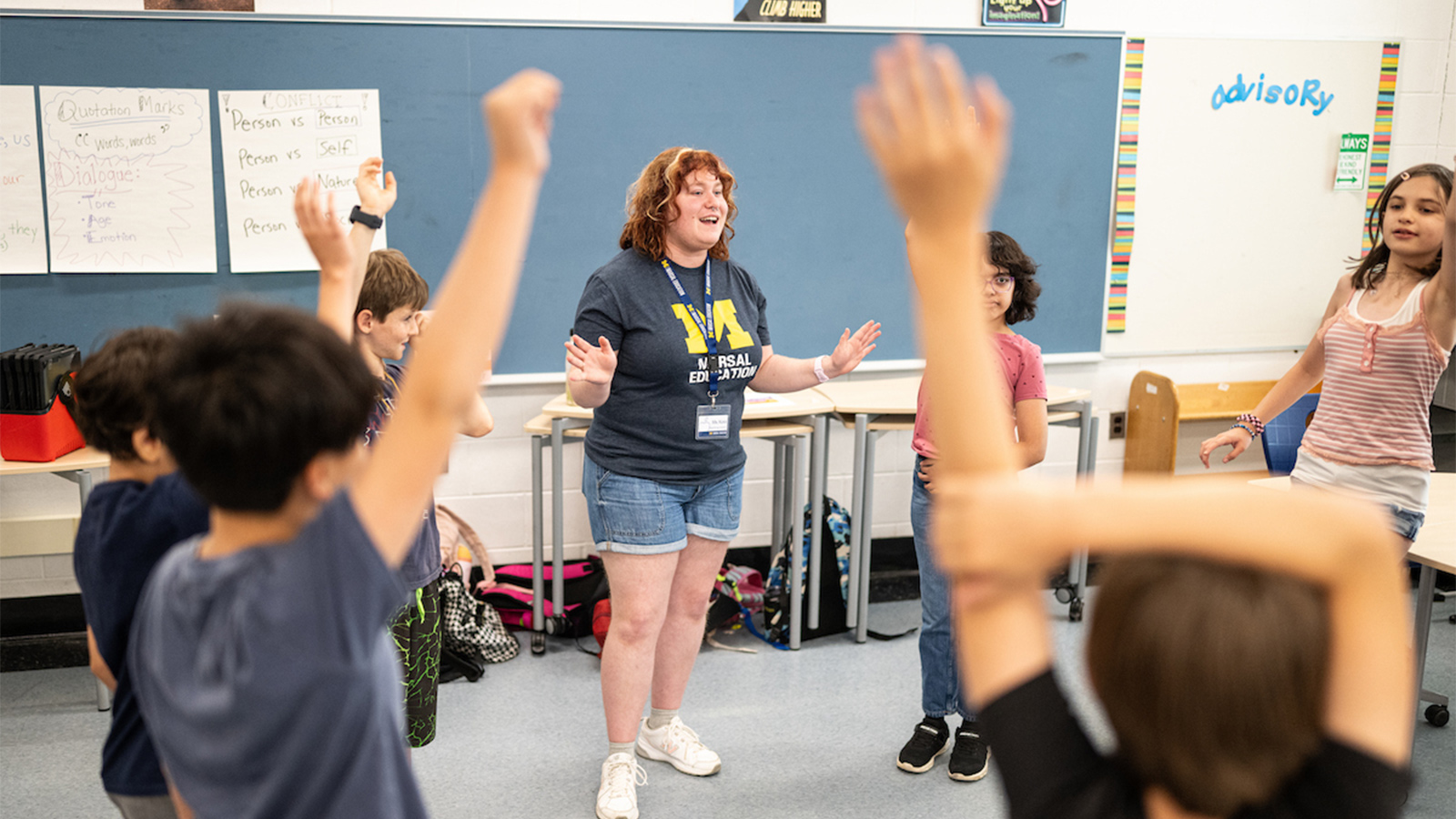
By Madeline Swanson | Photos courtesy of the Marsal Family School of Education
A successful school year starts well before the first bell rings.
Experts at the Marsal Family School of Education—who are preparing the next generation of teachers to meet the academic, social, and emotional needs of students in today’s complex learning environment—know that.
“We’ve always been great at teaching teachers how to make content real and important to students,” said Kendra Hearn, associate dean for undergraduate education & educator preparation programs. “But now, let’s do that with some sensitivity to who they are as whole beings and realize whole human beings go through things, even as children.”
Leaders & Best spoke with Hearn and Elizabeth Moje, Marsal Family School of Education dean, for practical advice on building better routines, stronger relationships, and meaningful learning—at school and at home.
1. Routines set the stage for a strong school day
Consistent sleep, nourishing meals, and predictable routines may sound simple, but they provide the foundation children need to learn.
That is especially important for teenagers, Hearn explains, whose developing brains often require more sleep. Rather than expecting children to move directly from a screen or activity to sleep, families can establish a short wind-down routine followed by a regular bedtime.
Device limits can be part of that routine—without treating technology as the enemy. Home boundaries can make school device policies easier to follow: When children already experience reasonable limits at home, putting a phone away at school is less likely to feel as though something has suddenly been taken from them, Hearn noted.
“It’s not because devices are inherently bad,” Moje added. “... But children also need time to play outside, talk with family, read, and engage in other activities.”
Food and punctuality matter, too, Hearn said. For families who use school meal programs, arriving early enough to eat breakfast can help children remain focused throughout the day.
2. Learn the teacher’s playbook
At times, parents and caregivers naturally draw on their own experiences as students, but today’s classrooms may look very different. That’s one reason Hearn encourages families to attend back-to-school nights, open houses, and curriculum events whenever possible.
“That’s your chance to learn upfront, early in the school year, what your child’s teacher has planned, what type of classroom they’re trying to create, and what they even expect of you as parents,” she said.
The bottom line? Teachers appreciate knowing they have an ally at home. Families, caregivers, and educators have different roles, but they share responsibility for supporting a child’s growth. Productive communication begins from that shared purpose: What are we noticing, and what can we try together?
3. Read anything—and talk about everything
Books count. So do comics, news stories, recipes, audiobooks, road signs, and even shampoo bottles and cereal boxes. Moje said the material matters less than helping children become curious, engaged readers who ask questions and make meaning, helping them to develop important critical thinking skills.
“The biggest message parents can send to children is that reading something is meant to engage you, and you’re meant to be asking questions,” she said. “It’s not just to get information; it’s to think.”
Hearn similarly encourages families to move beyond simply decoding words.
“Not just reading, not just decoding the words, but really thinking about what it is they’re reading and checking in for comprehension,” she said.
Parents can ask: Why do you think the author described it that way? What perspective might be missing? Those conversations strengthen comprehension and help children explain and support their own ideas.
With young children, read aloud and follow their questions—and do not underestimate their ability to wrestle with big ideas.
“For parents of very young children, remember that they can think too,” Moje said. “The more high-level conversation you have with them about really sophisticated concepts … the more they will think.”
4. Turn everyday life into a classroom
Learning becomes more memorable when children can connect it to something tangible.
Cooking, for example, is full of opportunities to practice fractions and measurement. If a recipe needs to be halved or doubled, narrate the math to your child instead of quietly doing the calculation yourself.
Families can also explore science while gardening or walking outdoors, use sports statistics to practice math, research neighborhood history, compare prices at the grocery store, or plan and budget for an outing.
The key is to begin with a question or subject the child genuinely cares about.
“Children learn best when they’re engaged in inquiry, when they’re engaged in projects that are meaningful to them,” Moje said.
Hearn agrees—active creation matters, adding that when children only consume someone else’s creativity through games, television, or other media, they miss opportunities to exercise their own.
5. Stay curious about their world
Marsal experts say grades tell only part of the story. Friendships, feelings, and experiences outside the classroom can have a powerful effect not only on how children behave, but how they learn.
Hearn encourages parents to stay attuned to changes in behavior: A child who begins isolating or suddenly loses interest in a favorite activity may simply be developing new interests, but the shift could also point to conflict with friends, academic pressure, or another difficulty.
Parents are often best positioned to notice those changes because they see their children across different settings and over longer periods than a teacher can.
Hearn advises parents to ask specific, low-pressure questions: Who did you spend time with today? What was the hardest part of your day? Is anything happening that you’re still thinking about?
Social media deserves attention as well. Hearn noted that online interactions frequently spill into school, affecting friendships and classroom dynamics. Age-appropriate monitoring and regular conversations about respectful online behavior can help children navigate those spaces.
Preparing teachers—and supporting students—for what comes next
There is no single checklist for raising a successful student, just as there is no one-size-fits-all method for teaching a classroom full of learners. But strong routines, meaningful learning opportunities, open communication, and attention to children’s whole lives can give families and educators a solid foundation to stand on.
At Marsal, teacher candidates are honing these skills from day one—whether it’s practicing building relationships with families through role-playing scenarios or learning to immerse their students in project- and place-based learning.
At the Marsal Family School of Education, named in recognition of a transformational gift from the family of Kathleen (ABEd ’72, TeachCert ’72) and Bryan Marsal (BBA ’73, MBA ’75) and their children, Megan Marsal Kirsch (ABEd ’14, TeachCert ’14) and Michael Marsal, philanthropic support helps make it possible to prepare future teachers for the complexity of today’s schools. Donors help advance field-based preparation, partnerships with schools and communities, research-driven teaching methods, and support for the well-being of both students and educators.
Together, Marsal experts and donors help prepare future teachers to teach effectively, connect with students, and create classrooms where every child can succeed.
Related Funds

Marsal Education Fund for Excellence - 364230
The Fund for Excellence is available to support the Marsal School's most pressing needs.

Marsal Education Fund for Teach Blue - 335685
Teach Blue provides opportunities for all who seek to enter and remain in the greatest profession through targeted effort

Marsal Education Student Scholarship Fund - 334567
This fund provides scholarships and financial aid opportunities to undergraduate and graduate students in the Marsal Fami
Related Stories
School of Education named in honor of Marsal family’s historic commitment
In recognition of gifts to the U‑M School of Education totaling more than $55 million, the Board of Regents approved a

Transforming futures
How life-changing education is helping students achieve their dreams
A new approach to teacher education
U‑M’s revolutionary Teaching School supports novice teachers in hopes of increasing retention rates and improving the

Crafting the future of learning
U‑M’s theme for the 2025-26 academic year, “Life-changing Education,” demonstrates how learning transforms lives.

Schools of the future
Despite the problems facing education, Elizabeth Birr Moje, dean of the School of Education, believes that out of turb