
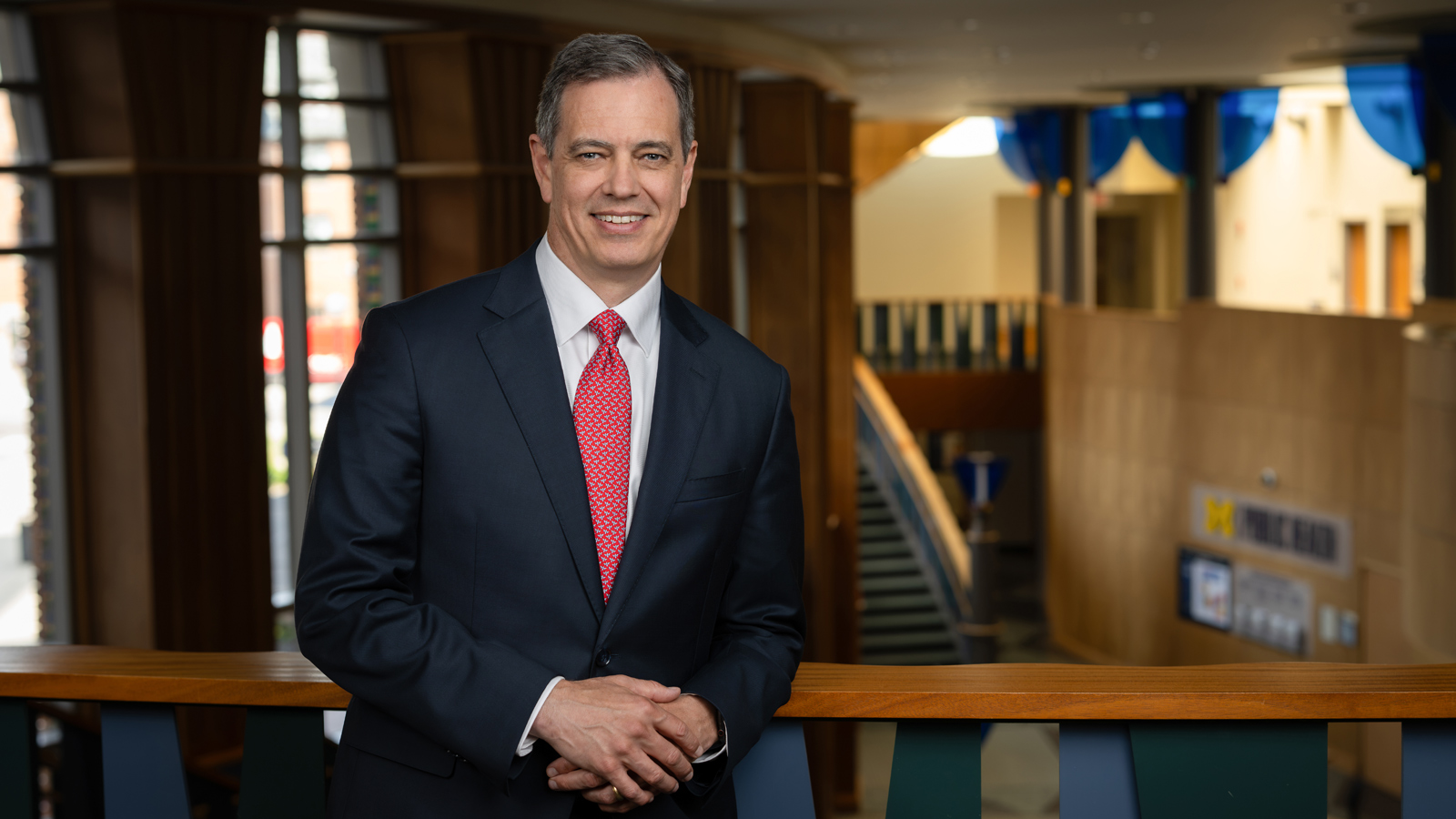
Photos courtesy of the School of Public Health
When Charles Holmes (MPH ’95) was appointed dean of U‑M’s School of Public Health in June, he had no illusions about the consequential task ahead of him. “Public health has never been more important for communities around the world, but it’s also never really faced such critical challenges,” he said in an interview with the school.
But optimism is shaping his approach to his new role. “What really excites me about stepping into the dean role is this opportunity to help shape the School of Public Health’s ability to build on its extraordinary strengths,” he said, adding “I think that the University of Michigan is poised to lead in public health because of its remarkable history and culture of collaboration.”
The Campaign Insider asked him about the challenges and opportunities that lie ahead, and how philanthropy can power the future of public health at Michigan.
You’ve been in your role just a short time, but what are your initial impressions of the unique challenges and biggest opportunities that Michigan’s School of Public Health is currently facing? What makes Michigan’s School of Public Health unique?
I’m thrilled to be back at Michigan Public Health after nearly 30 years working with colleagues around the world to lead public health organizations and programs. I was delighted to come back to find the same fire and passion for delivering on our mission of health and well-being for all people.
We are well positioned as the No. 4 school of public health, with exceptional students at both the graduate and undergraduate levels, and world-class faculty with a depth and range of expertise across the major challenges facing public health. We’re training the nation’s next generation of healthcare leaders, developing ways to prevent and treat infectious diseases that affect children across the world, we’re engaging deeply with communities—from Detroit and Flint to Alma and around the country—to understand their unique needs and opportunities.
No doubt there are significant challenges not just for us, but for all schools of public health: uncertainty in federal funding, a changing landscape for public health professionals, and an erosion of public trust. But that’s where I believe Michigan Public Health can be the leader our world needs. I’m focused on keeping the “public” in public health, by listening to communities, earning trust, and ensuring that our work responds to people’s needs. And I can’t think of a better place to demonstrate public health leadership like that than at the heart of one of the world’s great public universities.
At Michigan Public Health, we’re accustomed to creating impact in uncertain times. From the confirmation that the polio vaccine was safe and effective to the development of FluMist to understanding the health impacts of chemicals and air quality, we believe that research doesn’t stop at the academy’s door—and we intend to accelerate our work to turn research into action. That means designing and testing solutions with communities and making sure that health breakthroughs actually reach the people who need them most.
The challenges are changing, but our commitment to impact remains the same. AI and other technologies offer new opportunities to improve health, and we want Michigan to help shape how they are used. That includes preparing students to use these tools thoughtfully and responsibly, and working across the university to develop approaches that benefit communities here and around the world. Our global partnerships also allow us to learn from solutions developed in other countries and apply those lessons closer to home.
You were a student here a bit ago. What’s it like to be back?
Returning to Michigan Public Health as dean has reminded me how deeply this school shaped the way I think about public health—and the kind of colleague and partner I have aspired to be throughout my career. It is a privilege to come home to the place that prepared me for a career dedicated to improving health around the world. I return with deep gratitude for what Michigan made possible in my own life—and great optimism for what we can accomplish together for the next generation.
You have already been connecting with our donor and volunteer community. What are your impressions of these individuals?
I’ve had the chance to meet with some of our most generous and committed supporters—here in Michigan and across the country—and in every conversation, I see passion not just for the University of Michigan, but also for investing in the future of public health. Many Michigan Public Health alumni, myself included, credit the school with launching their careers and want to ensure that the next generation has those same opportunities.
Our alumni are leading some of the biggest healthcare systems in the country, working at the highest levels of government both here and around the world, and on the ground in communities, helping people live healthier lives. I’ve also met alumni from across the university—and supporters who didn’t go to school here—who have invested in our research, faculty, and students because they see what the school can contribute. They bring ideas, experience, and relationships, as well as financial support, and I’m eager to learn from them.
How do you see yourself further engaging with the Look to Michigan campaign and philanthropic efforts?
Being part of the Look to Michigan campaign is critical for our school, and I’m focused on working with individuals, corporations, and foundations to deliver on our mission. Student support, which is the top fundraising priority for the university, is also our top fundraising priority. We’re in an extremely competitive environment—in the United States alone, we’ve gone from 20 schools of public health several decades ago to over 200 now. It’s also no secret that changes to federal loans will impact those students who want to study public health, and it’s our goal that no student should be denied a Michigan Public Health education due to cost. Scholarships can also give graduates greater freedom to explore careers in communities where their skills are urgently needed.
Despite all the challenges, the School of Public Health received robust donor support last year. What do you attribute that to?
Donors care deeply about the School of Public Health and our efforts to train the next generation of health leaders and produce research that improves lives. In this time of increased uncertainty due to changes in the federal landscape and enrollment, we were deeply grateful to donors who showed increased generosity towards delivering on our mission of accelerating and improving human health.
We are deeply grateful for the support we saw last year, and yet this remains a challenging environment. We are reaffirming our efforts to ensure that a Michigan Public Health education is not out of reach for any student due to financial circumstances and that we can recruit, retain, and support the very best faculty and researchers.
Why is donor engagement and philanthropy so important to the mission and goals of the School of Public Health, in general, and in particular at this moment? How does philanthropy make a tangible difference in the work of SPH, and who ultimately benefits from this work?
I’ve seen first hand how philanthropy changes the world, and in my short time back at Michigan, the impact from philanthropy has already become clear to me. For example, this summer we were able to support multiple students to intern with the State Legislature and Department of Health and Human Services because of donor support, and we’ve seen investment from donors that has ensured critical research projects can continue.
I know that philanthropy opens doors for talented students, gives researchers the means to pursue discoveries that improve lives, and strengthens the communities that rely on the knowledge and leadership Michigan produces. I’ll also note that Michigan is the only school of public health among the top five nationally that does not have a “naming” endowment. We’re working diligently on this, because the opportunities that this level of endowment would provide for our students, faculty, and research would be transformative.
I invite individuals, corporations, community foundations, and other institutions to join us as partners in our mission in solving the most intractable health problems. Michigan Public Health has an 85-year history of doing just that, with donors as our partners. And in this moment of upheaval for public health and higher education, giving matters more than ever so we can invest boldly in our students, research, and innovative ideas.
Related Funds

Related Stories


Tags
Related Funds
SPH Emergency Scholarships - 322666
SPH Fund Emergency Scholarships are intended to help meet the financial needs of SPH students who encounter an emergen

SPH Fund - 362874
Unrestricted support to provide sustainable funding for the School of Public Health and to strengthen the student experie
Dean's Advisory Board Fellowship Fund - 312705
This fund provides fellowship support for students earning a degree at the University of Michigan School of Public Health
Related Stories

5 lifestyle hacks for a healthy new year
U‑M experts share simple lifestyle tips for a healthy 2026.
Health for all, one solution at a time
U‑M is making health and well-being a priority for the community and beyond.
Taking action for safer schools
The University of Michigan is making school safety a priority.

Urgent care
Ongoing health disparities could have catastrophic consequences. U‑M experts are working to prevent them by bringing t